There is a version of entrepreneurship that nobody puts on a motivational poster. It is the second year of running a business, when the initial momentum has faded, the early clients have gone quiet, and the gap between where you are and where you expected to be feels embarrassingly wide. That is where most of the real decisions get made.
After 25 years of running CREATE, we have watched hundreds of founders at exactly that junction. Some push through. Many do not. And the ones who walk away almost always do so just before something shifts.
The First Year Is Supposed to Feel Like Nothing Is Working
New businesses are not slow because of bad ideas or weak execution. They are slow because compounding takes time to build. A website needs months to earn search authority. A reputation needs repeat transactions to stick. A referral network needs to be genuinely useful before it starts sending work back your way.
The founders who understand this treat year one as infrastructure, not performance. They are laying pipe, not measuring water pressure. The results come — but not on the timeline that looked reasonable on a spreadsheet in January.
Forty Years for Someone Else, Three for Yourself
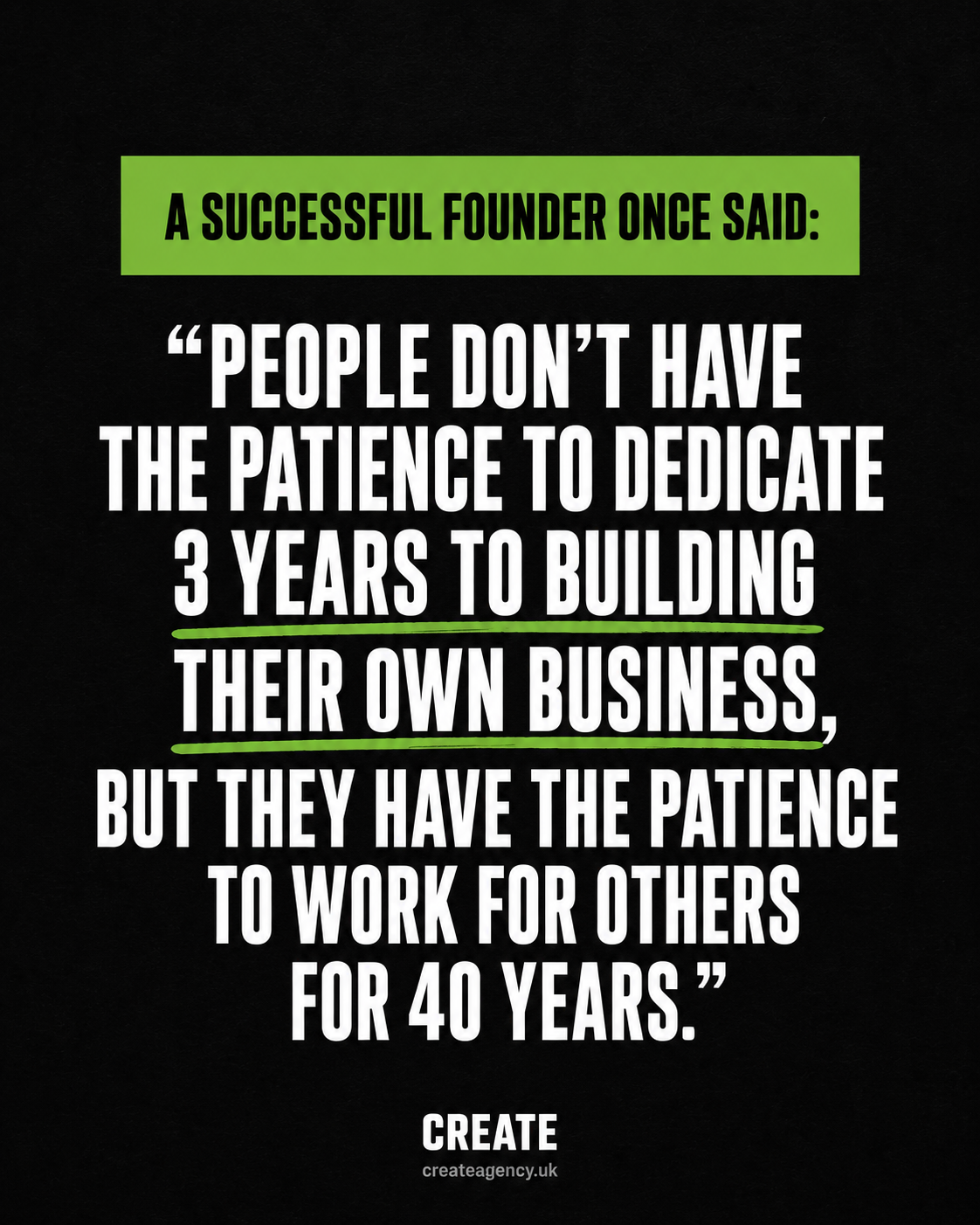
Most people will spend the better part of four decades contributing to someone else's growth before they are willing to tolerate even two or three difficult years building something of their own. That asymmetry is worth sitting with for a moment.
The employment contract offers comfort and certainty. A salary arrives whether the company had a good month or not. That is not a criticism — security matters, and not every business idea deserves to be pursued. But when the idea is sound and the execution is honest, the discomfort of early-stage business building is not a signal that something is wrong. It is simply the cost of entry.
Where the Breakthrough Actually Lives
We have seen this pattern repeat often enough to trust it: the businesses that eventually find their rhythm are almost always the ones that stayed operational just past the point where quitting felt rational. Not reckless — staying in business means managing cash, being honest about what is and is not working, and making changes when they are needed. But staying, nonetheless.
The breakthrough rarely announces itself in advance. It tends to arrive as a run of enquiries that suddenly does not dry up, or a client who refers three more, or a piece of content that keeps pulling in traffic two years after it was published. None of that happens for the people who are no longer there.
Compounding Is Not a Metaphor
In financial terms, compounding is simple arithmetic — returns generating returns over time. In business, the mechanism is the same, just less tidy. A well-optimised website compounds. A strong brand compounds. A library of useful content compounds. A reputation for doing what you say you will do compounds.
None of these things produce dramatic results in a short window. All of them produce significant results over a long one. The founders who treat their business as a long-term asset — rather than a short-term experiment — are the ones who eventually look back and struggle to identify a single moment when it all changed, because it changed gradually and then all at once.
What Staying in the Game Actually Requires
Persistence without adjustment is not a strategy. Staying in the game means being willing to look clearly at what is not working and change it — not abandoning the whole enterprise because year one was hard, but being honest enough to refine the offer, the positioning, or the marketing when the evidence suggests it is needed.
That is where outside perspective tends to earn its keep. Whether it is an accountant, a mentor, or an agency that has spent two and a half decades helping businesses grow their digital presence, the value is usually in helping founders see what they are too close to see themselves.
If you are building something and the early stages are grinding — that is normal. It does not mean you are failing. It means you are in the part that most people skip past on the way to talking about someone else's success story.
If you want to talk through where your business is and what the next move looks like, we are straightforward to reach.