Starting a business is straightforward enough. Staying in one when nothing appears to be working; that is the harder thing, and nobody warns you about it sufficiently.
We have been running CREATE since 2001. We have watched hundreds of founder-led businesses come through our doors at every stage of their journey, from the freshly launched and full of optimism to the quietly exhausted and wondering whether to pack it in. The pattern we see most often is not failure through incompetence. It is abandonment through impatience.
The uncomfortable truth is this: most businesses that close in their first three years were not fundamentally broken. They were just early.
The First Year Rarely Looks Like Progress
In year one, almost nothing compounds. You are building systems, finding your audience, learning what you actually sell versus what you thought you were selling. Revenue is inconsistent. Referrals have not started yet. Your website is new, so search engines largely ignore it. Your reputation exists only in a small circle.
This is normal. It is not a signal to stop. It is the cost of entry that most people are not fully prepared to pay.
The founders who make it through year one intact (not triumphant, just intact) tend to describe it the same way afterwards: grinding, confusing, occasionally demoralising, and entirely worth it.
Why Compounding Only Rewards the Patient
Compounding in business works exactly as it does in finance: slowly, then suddenly. Each piece of content you publish makes the next one easier to rank. Each client you serve well generates a referral you will not see for eighteen months. Each iteration of your product or service makes the next version sharper and more sellable.
None of this shows up on a Monday morning dashboard. It accumulates invisibly until, one quarter, you look back and realise the business looks nothing like it did eighteen months ago, in the best possible way.
The founders who quit at month eleven never reach that quarter. They exit the game just before the scoreboard updates.
The Forty-Year Comparison That Should Bother You
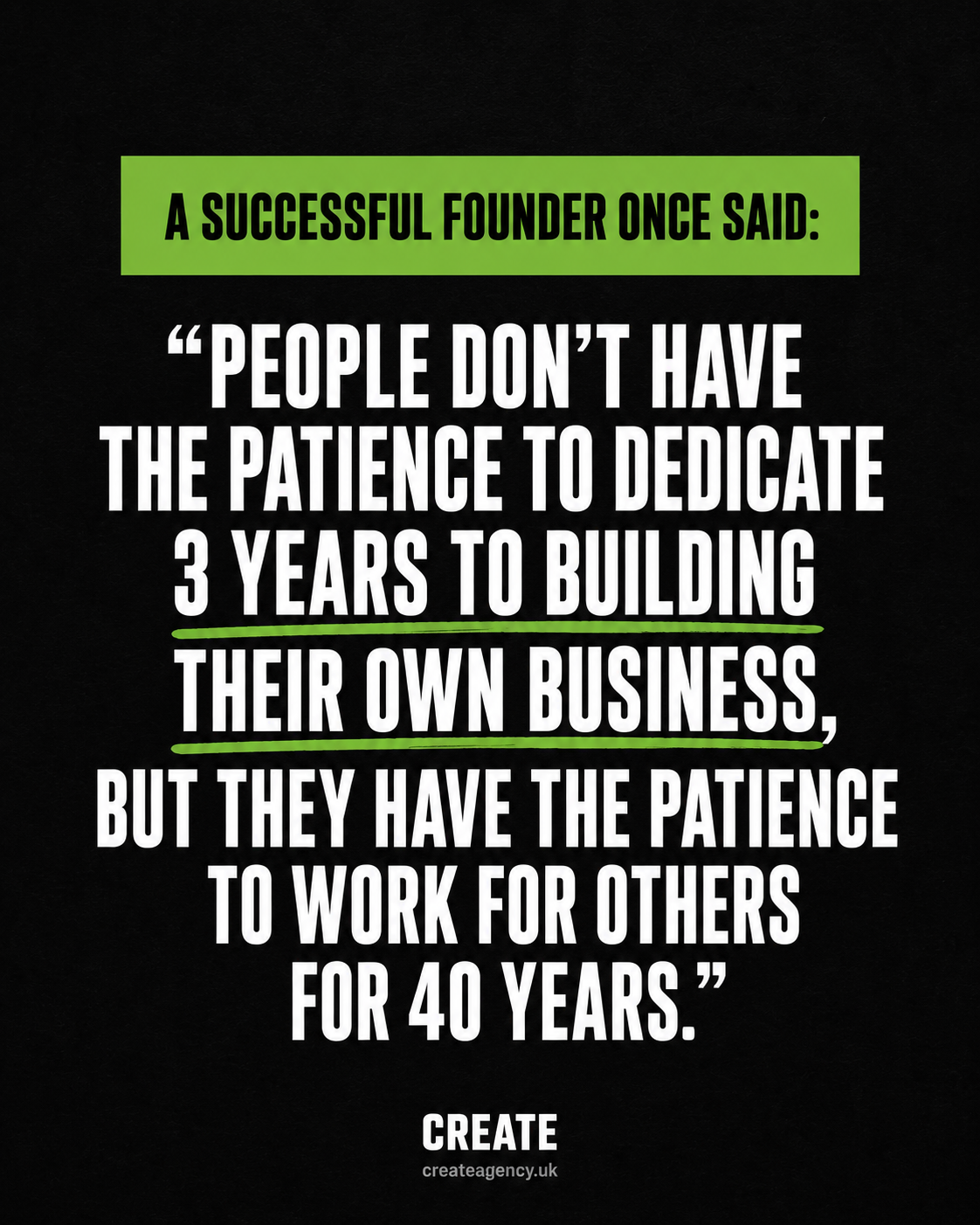
Most people will spend four decades building wealth and security for someone else before they spend three years attempting it for themselves. That is not a criticism of employment (it is a perfectly legitimate path), but it is worth sitting with the maths for a moment.
Three years of discomfort and uncertainty, if the business survives it, can produce something that pays you, grows without you, and exists on your terms. Forty years of employment security is certain in the short term and entirely contingent on decisions made by other people in the long term.
We are not naive about the risks of self-employment. We have lived them. But we are also clear that the window in which a business becomes genuinely self-sustaining is shorter than most people imagine, provided you do not walk away before you reach it.
What 'Staying in the Game' Actually Means
Persistence is not the same as stubbornness. Staying in the game does not mean repeating the same actions and expecting different results. It means iterating, asking difficult questions, adjusting the offer, finding the right channels, and being honest about what is working and what is not.
In practical terms, that might mean revisiting your positioning after twelve months. It might mean investing properly in your digital presence instead of hoping people will find you. It might mean accepting that the version of the business you launched is not quite the version of the business the market wants, and being willing to close the gap.
The founders who endure are not simply more resilient. They are more willing to act on what the evidence is telling them, even when it is uncomfortable.
The Breakthrough Tends to Arrive After the Doubt
Almost every founder we have spoken to can identify a specific moment when they nearly stopped. Interestingly, for a significant number of them, the breakthrough (the first major client, the referral that changed everything, the campaign that finally clicked) came within months of that moment.
That is not coincidence or comfort. That is the nature of a process that rewards time in the market over timing the market.
If you are building something and it feels like nothing is working, that feeling is data, but it is not a verdict. The question worth asking is whether the fundamentals are sound, and whether you have genuinely given the compounding enough time to begin.
If you are at that inflection point and want a honest conversation about your digital presence, your positioning, or where to focus next, we are easy to reach. No pitch, no obligation, just a straight conversation with people who have been doing this for a long time.