Every page a website has ever published is a small deposit in Google's index. Not glamorous, not visible day to day, but real value built up quietly over months and years of crawling, indexing, and ranking.
Then someone rebuilds the site. Every address changes. The old URLs vanish and start returning 404s. The rankings go with them, along with every backlink anyone ever pointed at the old pages, and every result a customer bookmarked or shared on social media three years ago.
It is the single most common reason a brand new, better-looking website performs worse than the tired old one it replaced. It is also completely avoidable, which is what makes it so frustrating to see happen again and again.
Why A Redesign Can Quietly Wreck Your Rankings
Google does not automatically know that yoursite.co.uk/news/old-article-name is now yoursite.co.uk/blog/old-article-name. As far as the index is concerned, the old page has disappeared and a new, unrelated page has appeared in its place. Any authority, trust, and ranking history attached to that URL does not transfer across on its own.
Multiply that by every page, post, and product on a site and the damage adds up fast. A business that spent years earning organic traffic to its news section can watch that traffic collapse within weeks of a relaunch, simply because nobody mapped the old structure to the new one.
It is not just Google that gets confused. Anyone who bookmarked a page, linked to it from another site, or shared it on LinkedIn a year ago will hit a dead end too. That is lost referral traffic and a poor impression of the business on top of the SEO hit.
The Fix Is Boring, Which Is Why It Works
There is no clever trick here. The process is deliberately unglamorous:
- List every URL the existing site has, including the ones nobody remembers are still getting traffic
- Decide exactly where each one should now live on the new site
- Write a 301 redirect for each mapping so visitors and search engines land in the right place automatically
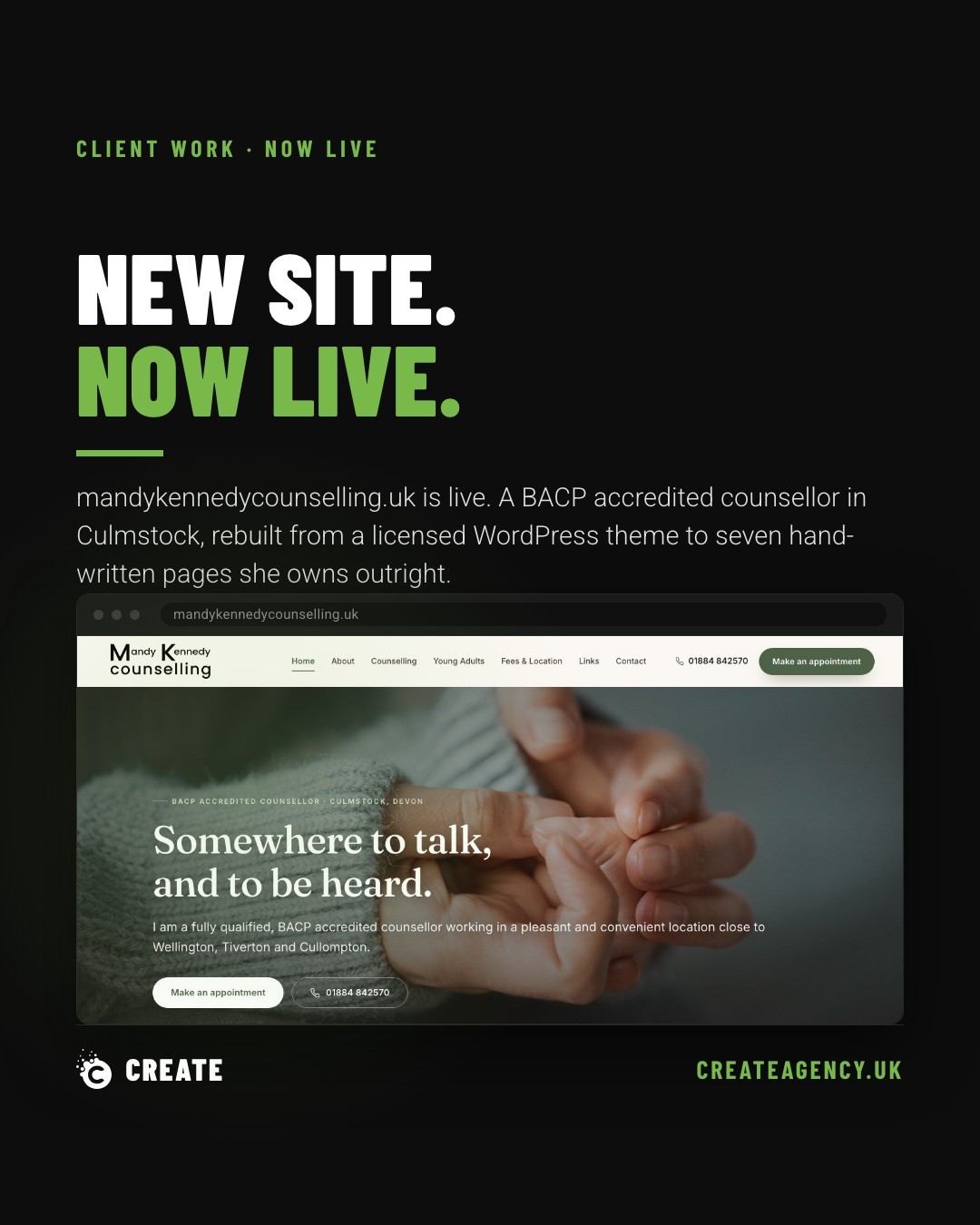
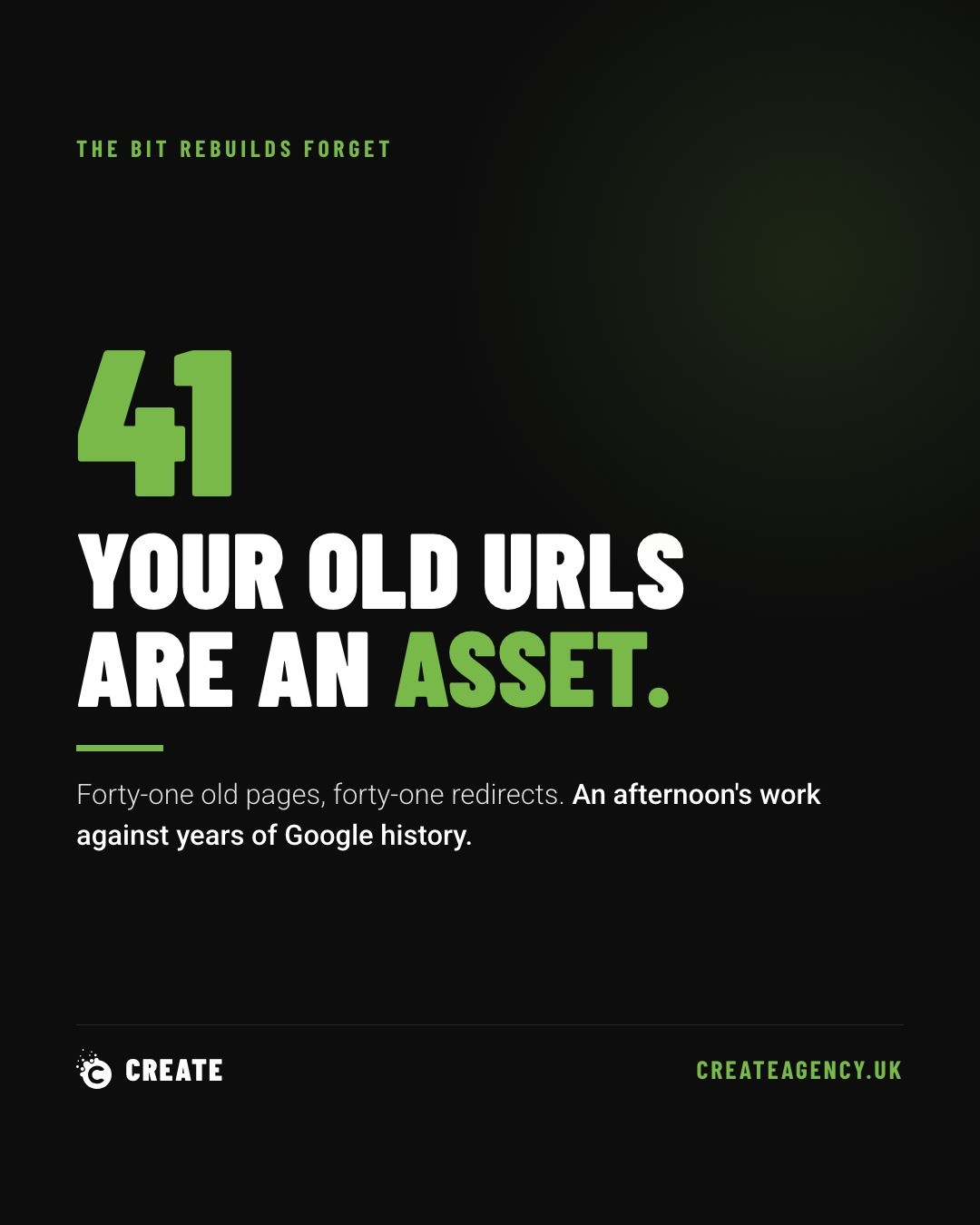
On a rebuild we finished this week, that meant 41 news posts plus a handful of legal and policy pages. Going through the list, mapping each one, and writing the redirects took an afternoon.
An afternoon of careful, slightly tedious work against years of accumulated search visibility is not a difficult trade to make. Most businesses would take that deal every time, if anyone told them it was on the table.
The One Question Worth Asking Before Any Redesign
If a business is being quoted for a website redesign, there is one question worth asking before signing anything: what happens to the existing URLs.
A good answer sounds like a plan: an audit of current pages, a redirect map, testing before launch. A vague answer, or worse, a shrug, tells you the agency has not thought about it, and possibly has not dealt with the consequences of getting it wrong before.
This matters just as much for smaller sites as large ones. A five-year-old local business site with forty pages can lose just as much relative value as a two-hundred-page e-commerce store if nobody bothers to check what is being thrown away.
What To Check If A Rebuild Has Already Happened
For anyone reading this after the fact, because the new site has already gone live and traffic has quietly dropped, it is worth checking Google Search Console for a spike in 404 errors and crawl issues. That is usually the clearest signal that old URLs are dead ends rather than redirected.
The fix at that stage is the same as before a launch: list the old URLs (Search Console's historical data or an archive tool like the Wayback Machine can help reconstruct them), map them to their nearest equivalent on the new site, and put the redirects in place. It is more work after the fact than before it, but it is rarely too late to recover most of the lost ground.
Redesigns should make a website better, not quietly undo years of work nobody thought to protect. If a rebuild is on the horizon and the question of what happens to the old URLs has not come up yet, it is worth raising before the first line of code gets written. We handle exactly this kind of migration as part of our web development work, and if it would help to talk through what a rebuild would mean for an existing site's rankings, get in touch and we will walk through it properly.