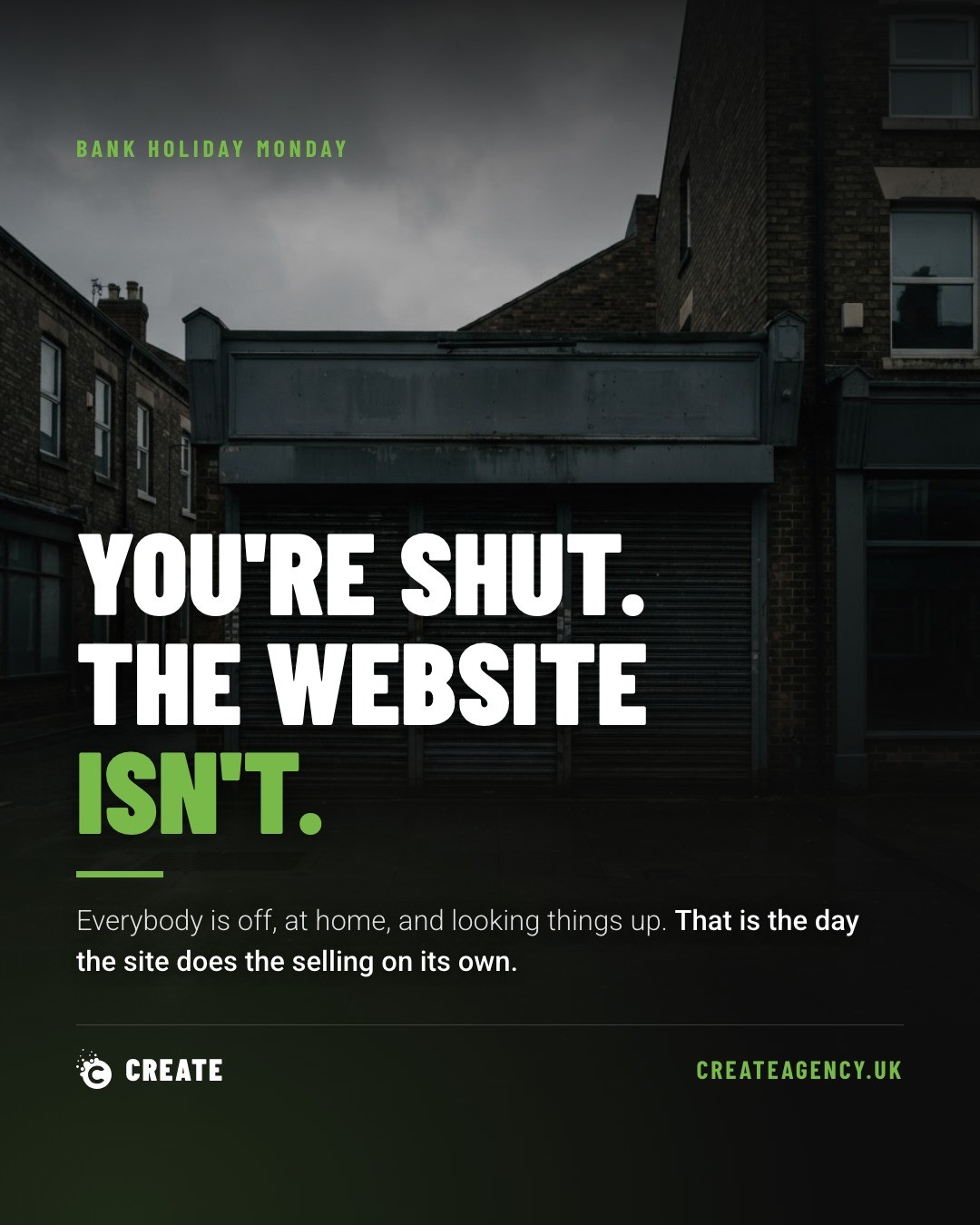
A bank holiday is the quietest working day of the month for most businesses and one of the busiest for people making decisions at home. The office is closed. The phone is off. Someone is on the sofa deciding who is going to do the extension, which florist to book, or whether that place nearby does the thing they need.
On that one day, the website is not supporting the business. It is the business. There is nobody to pick up the phone and smooth over a confusing page or answer a question a form did not ask. Whatever the site does on its own is what happens.
That makes bank holidays a useful, if uncomfortable, test. Not because the problems are new, but because it is the day they actually show up.
Can Someone Get a Price Without Ringing You
A huge amount of small business web design still assumes a phone call is coming. "Call for a quote" works fine on a Tuesday afternoon when the office is staffed. It does nothing at 8pm on a Monday when the phone rings out.
If pricing, even rough pricing, is not visible or estimable somewhere on the site, a chunk of visitors will simply leave and try a competitor who has published theirs. This is not about revealing every commercial detail. It is about giving someone enough to decide whether to bother getting in touch at all.
Is There an Obvious Next Step
Walk through the site as a stranger would, on a phone, with no prior knowledge of the business. At the point of interest, whether that is a service page, a product, or a location, is it obvious what to do next?
Too many sites end at a paragraph of text with no clear action. Nothing to click. Nothing to fill in. The visitor is left to hunt for a contact page buried in a menu, and most will not bother. A good site makes the next step unmissable, whether that is a form, a booking link, or a click-to-call button.
Does the Form Actually Go Anywhere
This one catches out more businesses than expected. Forms get set up, tested once at launch, and then forgotten. Email addresses change. Spam filters quietly reroute submissions. Staff leave and nobody updates the notification settings.
A form that silently fails is worse than no form at all, because the customer believes they have made contact when they have not. Worth checking, properly, not just glancing at the confirmation message but confirming a real message lands in a real inbox someone reads on Tuesday morning.
Are the Opening Hours Actually Right
Google Business Profile listings, and any hours shown on the site itself, need to reflect reality on public holidays specifically. It is a small detail with an outsized effect: a listing that says "open" when the business is shut sends someone away annoyed, and a listing that says "closed" when the business is trading loses a sale to a competitor who bothered to update theirs.
This is a five-minute job that gets skipped because bank holidays creep up. Setting a recurring reminder ahead of the main UK bank holidays each year solves it permanently.
None of This Is a Bank Holiday Problem
Every one of these issues exists 365 days a year. Pricing that requires a phone call, forms that vanish into the void, pages that lead nowhere, listings nobody checks: these cost enquiries every single week, quietly, in ways that are hard to trace back to a cause.
A bank holiday just removes the safety net of a person answering the phone to catch what the website misses. For one day, the site has to do the whole job on its own. Whether it manages that is worth finding out before the next one arrives.
If a walk-through of the site on a quiet day throws up more questions than it should, we can help fix it. Have a look at our web development services or book a call to talk through what is actually costing enquiries.