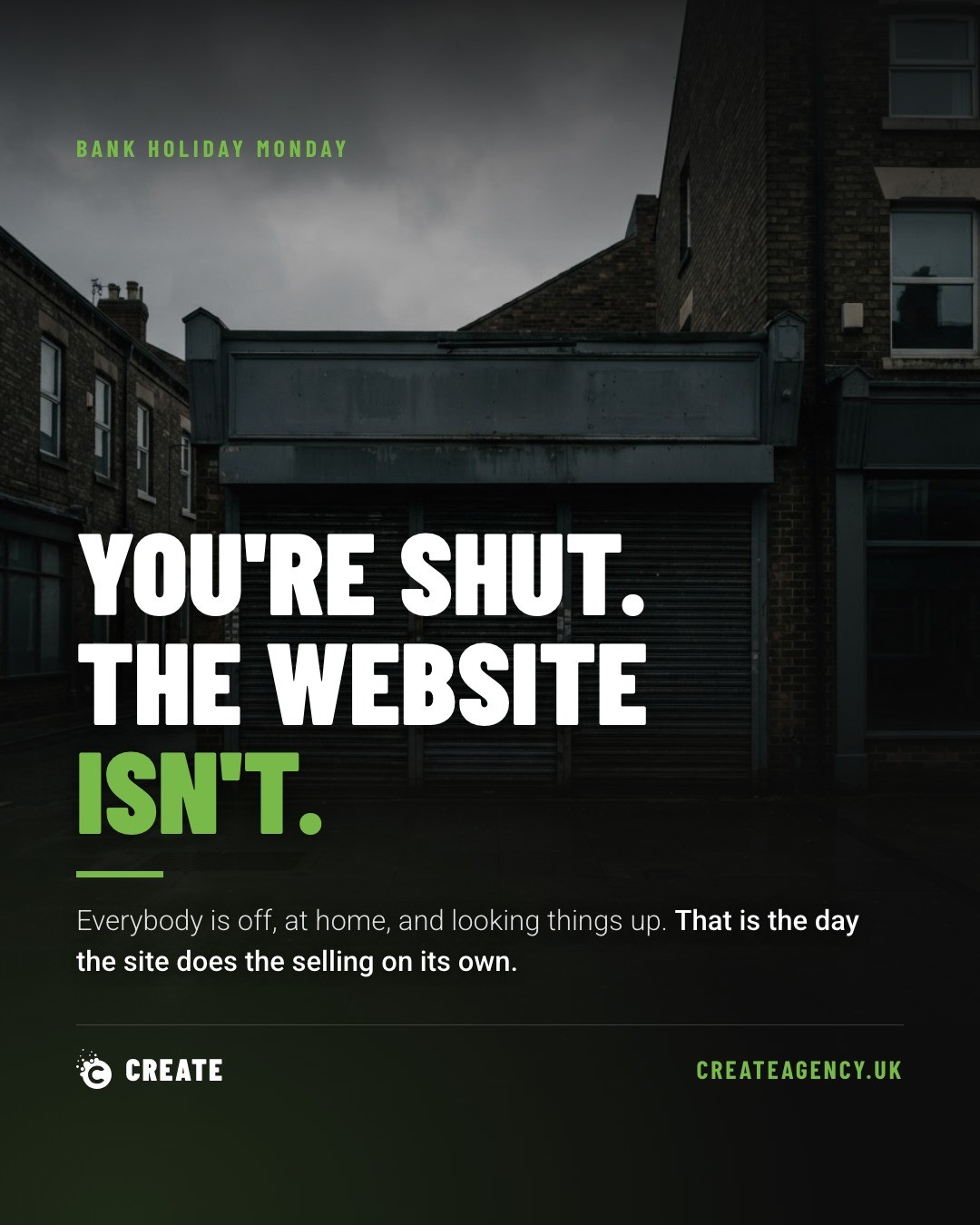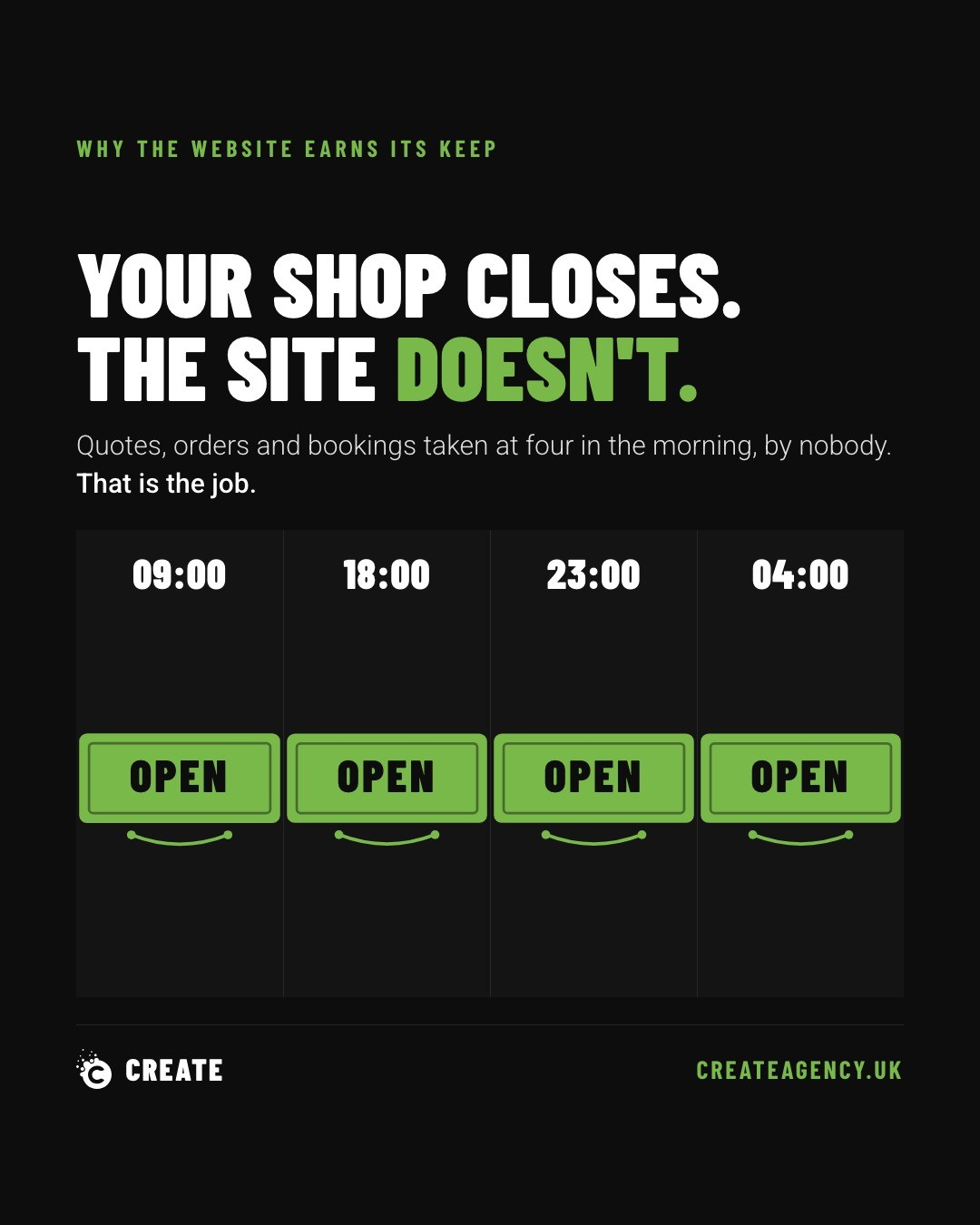
Somewhere around ten past eleven on a Sunday night, a customer decides they want a price, a slot, or a delivery. They are on their phone, card in hand, ready to buy. The question is what your website lets them do about it right then, not on Monday morning when someone finally opens the inbox.
That single question, what can a customer actually complete without anyone at a desk, is the one we keep coming back to. Design matters. Photography matters. But neither of those things pays an invoice at midnight. Only a site built to transact does that.
The overnight test every small business site should pass
We run a simple test on every build: if a customer lands on the site at midnight, ready to spend money, what happens next? There are really only two outcomes.
Either they can get a price, book a slot, or place an order there and then, or they read some copy, fill in a contact form, and wait for a reply that might not come until Tuesday. The first outcome is a sale. The second is a missed order, and it repeats every single night the site stays that way.
This isn't a design flaw you can fix with a nicer layout. It's a structural gap between what the business actually sells and what the website is built to do.
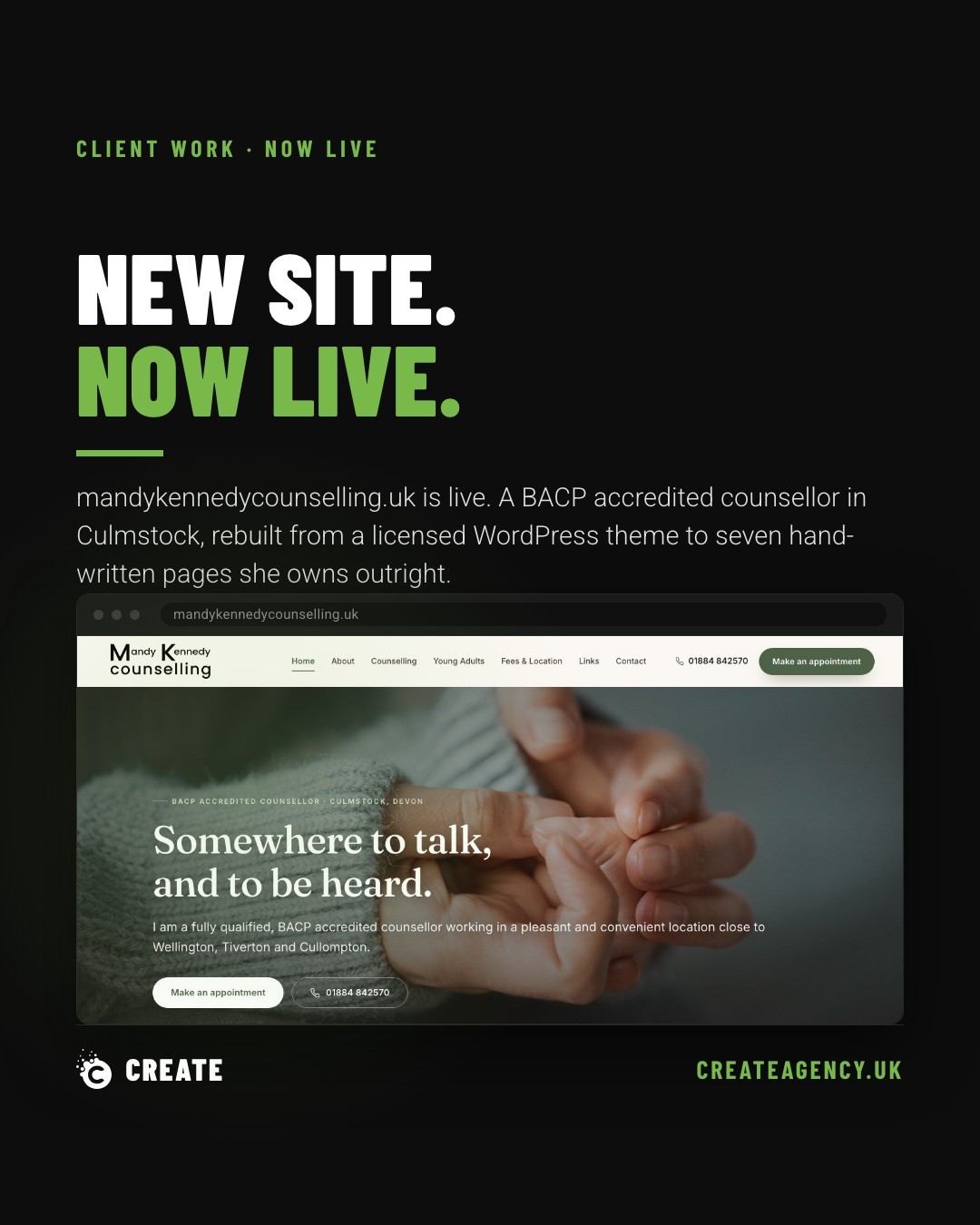
What we've actually built this month
Every project we finished recently has this baked in, because the brief demanded it, not because it was an add-on.
A florist now takes card payments for same-day delivery, so an order placed at 9pm is already in the system by the time the shop opens. A hire company quotes a fourteen-day rental directly off its own rate card, no phone call needed, no waiting for someone to check availability. A claims firm takes full incident details while the customer is still stood at the roadside, engine ticking over, rather than losing that information to a missed callback the next day.
None of these are complicated builds in the traditional sense. They don't rely on flashy front-end tricks. What they share is that the back-end logic (pricing, availability, payment) is exposed to the customer directly, instead of being locked behind a form that routes to a person.
Why the contact form is usually the weak link
A contact form feels safe. It captures an enquiry, it looks professional, and it gives the business time to respond properly. But time is exactly what a midnight customer doesn't want to give.
If the honest answer to "what can they do right now" is fill in a form and wait, that's not a minor inconvenience. It's the difference between a booked job and a customer who has already found someone else by breakfast. Small businesses lose more revenue to this gap than to almost any competitor's pricing or marketing.
The fix isn't always e-commerce in the traditional sense. A hire company doesn't need a shopping cart; it needs its rate card connected to a booking calendar. A claims firm doesn't need a checkout; it needs a structured form that captures everything an assessor would ask for, submitted the moment the incident happens rather than recalled from memory two days later.
Working out where your own site falls short
Start by asking what a customer with money to spend, arriving outside office hours, can actually finish unaided. Walk through the journey as if it's 11pm and there's nobody in the building.
Can they see real prices, not