Search behaviour has quietly changed. A growing number of people no longer type a keyword into Google and scroll through ten blue links. They ask a full question in ChatGPT, Google's AI answers, or Perplexity, get a written reply, and act on it without ever visiting a website.
That is a problem if your website was built for the old model. Ranking well used to be the whole game. Now the page also has to be legible to a machine that intends to summarise it, extract the facts, and quote them to someone who will never click through to see where they came from.
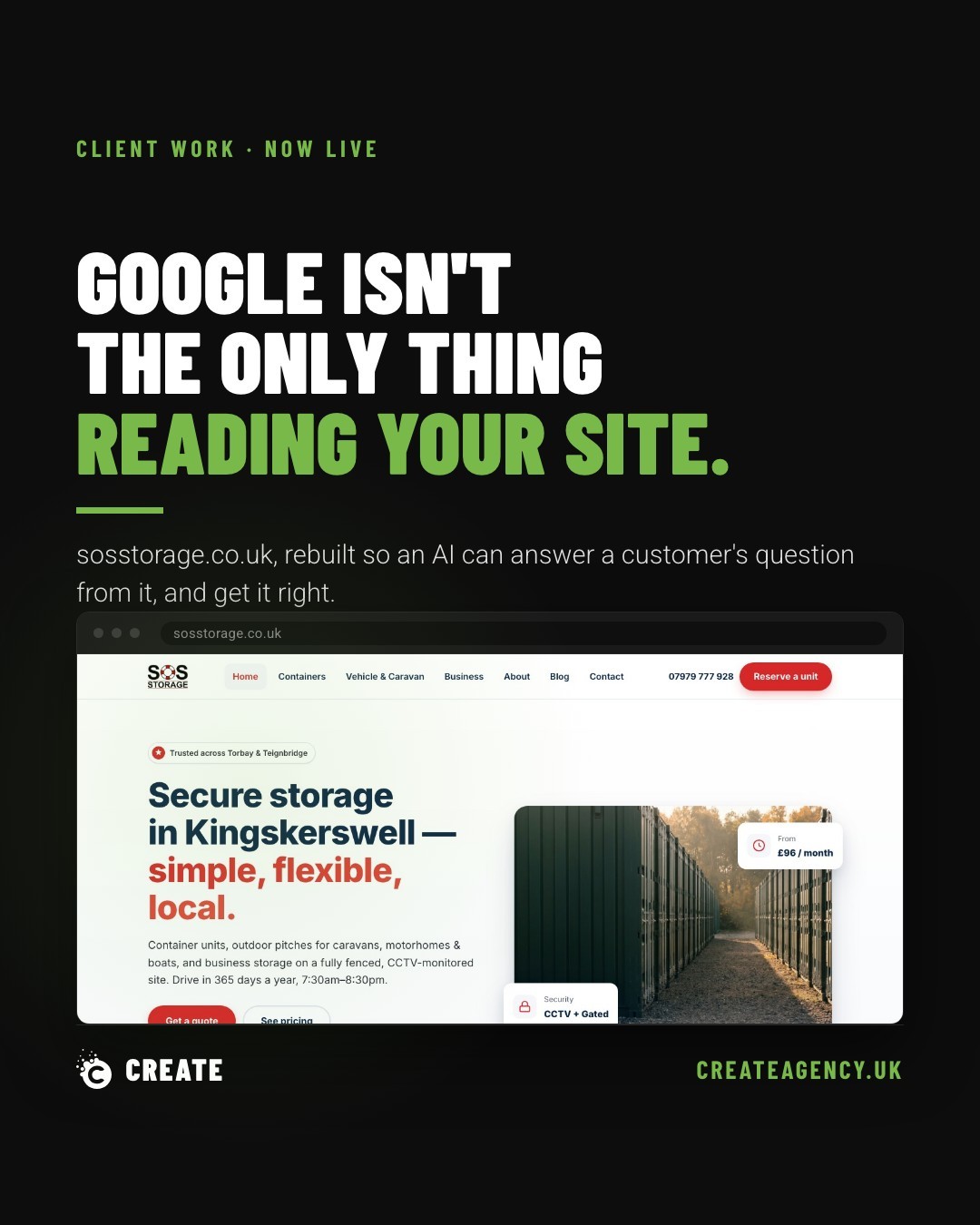
We ran into this directly with SOS Storage, a self-storage business in Kingskerswell, Devon. Their site ranked reasonably well in traditional search. It was almost invisible to AI answer engines. Here is what we changed, and why each piece mattered.
Turning Prose Into Facts
Most websites bury their useful information inside sentences. Prices, opening hours, location and services get woven into marketing copy, which is fine for a human reader but frustrating for a machine trying to extract a straight answer.
We added structured data to every page on the SOS Storage site, stating prices, hours, location and services as explicit facts rather than leaving an AI system to infer them from paragraphs. This is the same principle search engines have used for years with schema markup, but it matters more now because AI tools lean on it heavily when deciding what to quote.
Answering the Question the Page Is Named After
Every page has an implied question. A page titled "storage units in Newton Abbot" is implicitly answering "where can I find storage units in Newton Abbot". Most sites never actually answer that question in plain terms; they talk around it.
We added a direct answer near the top of each page, written as a straightforward reply to the question the page exists to serve. It reads naturally to a visitor, but it also gives an AI system something clean and quotable to lift, rather than forcing it to guess at meaning from marketing language further down the page.
Six Towns, Six Genuinely Different Pages
SOS Storage serves customers across Kingskerswell, Newton Abbot, Torquay, Paignton, Brixham and Teignmouth. The lazy approach to local SEO is one template page with the town name swapped in six times. Both Google and AI systems have got much better at spotting that pattern, and it does nothing useful for the person actually asking about storage in Brixham specifically.
We built six proper town pages with genuinely different content, reflecting what is actually relevant to each location: nearby landmarks, local access routes, and the specific reasons someone in that town would choose that branch. It is more work than duplicating a template, but it is the difference between a page that reads as authentic and one that reads as filler.
Inviting the AI Crawlers In
A surprising number of websites block the very crawlers that feed AI answer engines, often by accident. Default configurations, old security plugins, or a developer being cautious a few years back can leave GPTBot, ClaudeBot, PerplexityBot, OAI-SearchBot and Applebot locked out without anyone realising.
We checked and updated the robots.txt file for SOS Storage to explicitly welcome all five. We also added an llms.txt file, a plain-text summary of the site that these systems look for specifically. It is a small technical step that costs almost nothing and closes a gap most sites do not know they have.
Cleaning Up the Digital Debris
SOS Storage had migrated away from WordPress at some point before we got involved, but the old URLs were still sitting in Google's index, all quietly returning 404 errors. Every one of those is a small vote of confusion sent to any system trying to understand the site, and a dead end for anyone who clicks through from an old bookmark or a stale search result.
We redirected every old URL to the page that replaced it, tidying up 45 pages in total across a rebuilt sitemap, all saying the same thing consistently about who SOS Storage is and what it offers.
The Site Looks the Same. What It Says Has Changed.
None of this involved a redesign. Visually, the SOS Storage site looks much as it did before we started. What changed is whether the thing increasingly deciding who finds a business online can actually read it, understand it, and trust it enough to quote it.
That is the shift most businesses have not caught up with yet: the audience for a website now includes machines that summarise it on someone else's behalf, and turning up in that summary depends on different groundwork to turning up in a search result.
If a website has not been checked against what AI answer engines actually need, that is worth doing before it becomes a bigger gap to close. We work through exactly this kind of technical and structural review as part of our SEO and web development services, and we are always happy to talk through what it would mean for a specific site. Book a call if that is useful.