There is a moment that happens to almost every business with a website, usually at the worst possible time. The enquiry form stops working. Nobody notices for three weeks because nobody was looking. When someone finally asks why the phone has gone quiet, the answer is always the same: two suppliers pointing at each other while the actual problem sits untouched.
That happens because most agencies build a site, hand over a login, and consider the job done. The client is left holding a relationship with a developer who built it and a separate relationship with a host who runs it. When something breaks, working out whose fault it is becomes the first job, and it is rarely quick.
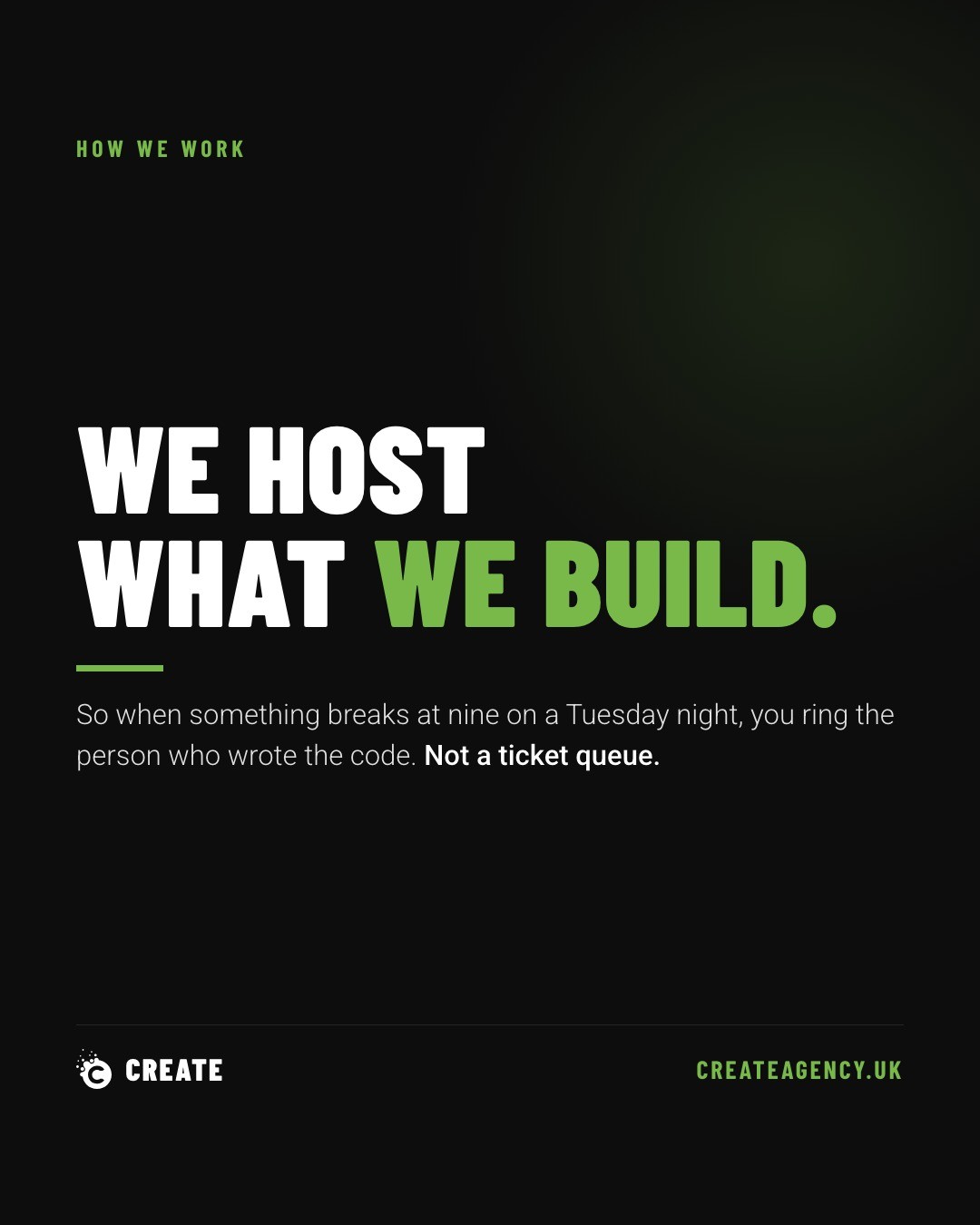
We do it differently. We keep hold of the websites we build. Not because we want to lock clients in, but because splitting build and hosting across two suppliers creates exactly the kind of gap where problems hide.
The Problem With Splitting Build and Hosting
When a developer builds a site and someone else hosts it, every fault has two possible homes. Is the error in the code or the server configuration? Is the certificate expired because of a hosting lapse or a settings change nobody flagged? Whoever answers the phone first has an incentive to say it is not their problem, and the client is stuck in the middle chasing an answer while the issue keeps costing them money.
This is not a rare edge case. It is the default setup for a huge number of small and medium-sized businesses, and it works fine right up until it doesn't. The day it doesn't work is usually the day a form stops submitting, a payment gateway silently fails, or a certificate expires and browsers start warning visitors the site is unsafe.
What Keeping Ownership Actually Looks Like
There is nothing dramatic about how we run the sites we build. That is rather the point.
We watch server logs, so we typically see an error before a client ever notices anything is wrong. Backups run every night, and we have actually restored from them, which is a genuinely different thing from simply having backups sitting untested on a drive somewhere.
Certificates renew on schedule. PHP versions get moved forward as old ones reach end of life. None of this generates an email, a support ticket, or a call asking a client to authorise anything. It just happens, quietly, in the background, because it is our infrastructure and our responsibility.
And when a client does need to ring us, they get the person who actually wrote the code, not a first-line support agent reading from a script and promising to escalate.
Why This Matters More Than It Sounds Like It Should
None of this is the kind of thing that makes it onto a homepage. Nobody chooses an agency because of nightly backup routines or PHP version management. But it is the reason clients stay with us long after the initial project is finished.
A website is not a one-off deliverable. It is infrastructure that a business depends on every single day, for enquiries, for sales, for credibility. Treating it as something you build once and then walk away from ignores that a huge part of its value is in how reliably it keeps running.
The cost of getting this wrong rarely shows up as a dramatic outage. It shows up as slow enquiry forms nobody flags, a lapsed certificate that quietly dents trust, or three weeks of leads vanishing into a broken integration before anyone thinks to check.
The Real Question to Ask About Your Own Setup
If a current website setup means chasing two different suppliers every time something breaks, that is not really a technical problem. It is a structural one, built into how the work was divided up from the start. And structural problems have a habit of surfacing on the day a business can least afford them, during a launch, a sale, a busy trading period.
Worth asking honestly: when the website next has a problem, is there one number to ring and one person who can actually fix it, or is there a queue, a login somewhere, and a conversation about whose fault it is?
We have built and maintained more than 500 projects over three decades from our studios in Devon and Dubai, and this is one of the quieter reasons clients keep working with us long after launch day. If a current setup is starting to feel like more admin than it should be, it is worth having a conversation about what a properly owned, properly maintained website actually looks like.