Most vehicle hire websites do the same job a phone call used to do. They tell you a bit about the fleet, list some rough prices, and then ask you to call for a quote. That last step is where the customer usually goes elsewhere.
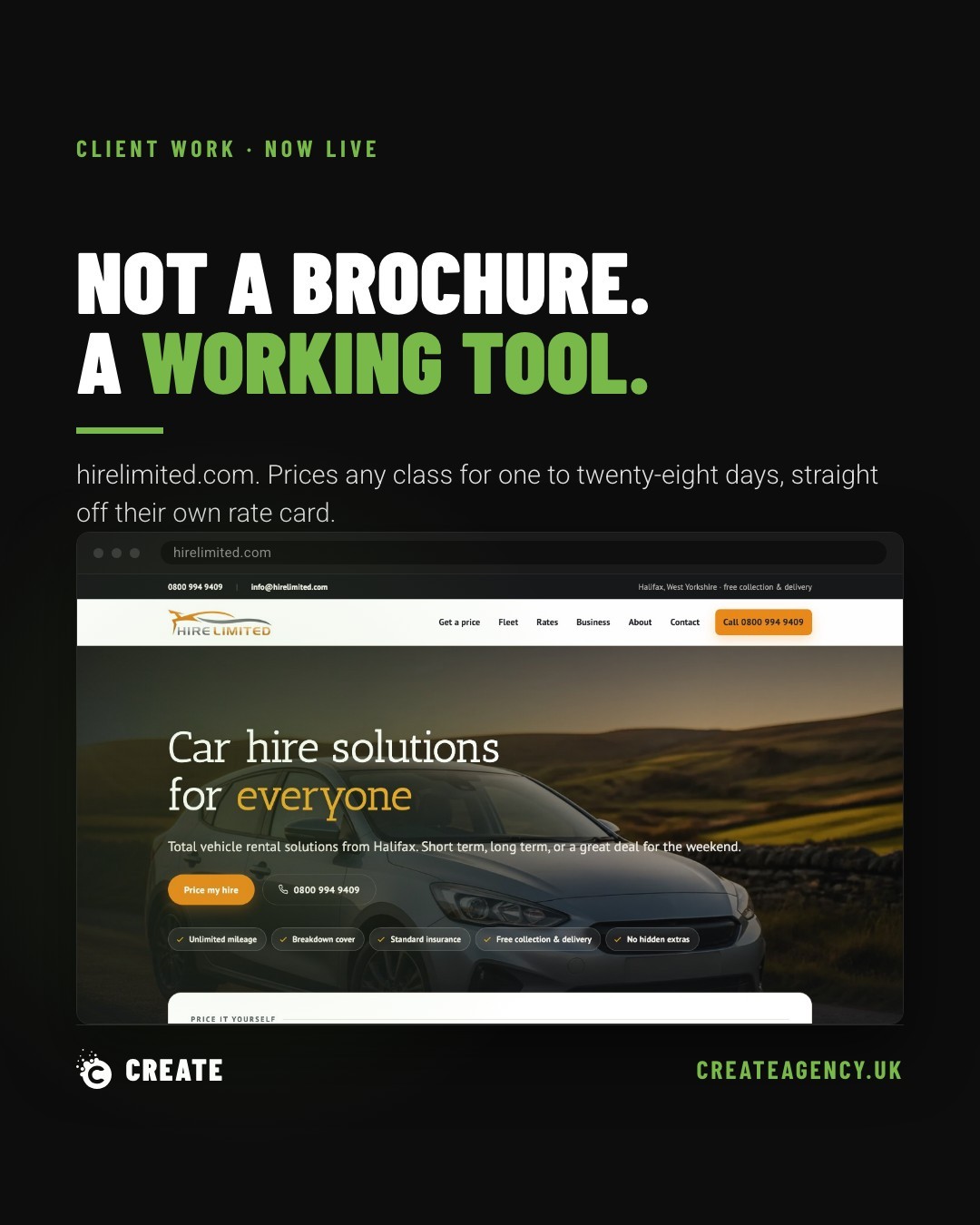
hirelimited.com does something different. Pick a vehicle class and a number of hire days, and the site prices it there and then, off Hire Limited's real rate card, for anywhere between one day and twenty-eight. No form to submit, no call-back promised for later. The answer arrives while the person is still on the page.
That sounds like a small thing. It isn't. It's the difference between a brochure and a tool, and it changes what the website is actually for.
The Quote Engine Does the Maths Nobody Wants To Do
The part we're genuinely pleased with is the rate logic running underneath the page. Daily hire rates and weekly hire rates don't always scale in a straight line. Hire something for six or seven days and the weekly rate is often cheaper than paying for six or seven individual days.
Most customers don't know that. Most customers wouldn't think to ask. So the engine checks it automatically: if the weekly rate works out cheaper than the day rate for the length of hire requested, it charges the week and says so on screen. Nobody has to spot the saving or negotiate for it. The site does the comparison every single time, instantly, and shows its working.
It also stops at twenty-eight days, because that's the limit in Hire Limited's own terms. That's a deliberately unglamorous detail, but it matters: the tool reflects the actual business rules, not a simplified version of them that looks good in a demo and breaks in production.
Why a Working Price Beats a Polished Page
A lot of commercial websites are built to look credible rather than to be useful. Nice photography, a confident headline, a contact form. That approach works when the customer's next step is genuinely a conversation, a bespoke quote that needs a human, a project with too many variables to price on a page.
Hire is not that. Hire is a defined product with a defined price, and the customer already knows roughly what they want when they land on the site. Making them wait for a call-back to hear a number they could have got from the website is friction with no upside. It gives the customer time to go and check a competitor's price instead, and in a market with several hire firms doing very similar things, that gap is exactly where deals go missing.
Building the pricing logic into the site itself removes that gap. The person asking the question gets the answer before their interest has had time to cool.
Rebuilding Our Own Work Was the Uncomfortable Part
There's a detail in this project worth being honest about. The site hirelimited.com replaced was one we built back in 2015. Ten years is a long time in web development, and going back to audit our own old work wasn't entirely comfortable.
Some of the decisions that made sense in 2015, static pages, a simple enquiry form, a design built for a smaller screen era, don't hold up against what a hire business needs now. Customers expect instant answers. Rate structures have got more complex. Mobile traffic dominates in a way it didn't a decade ago. None of that is a criticism of the original build; it's just what happens when a website outlives its assumptions.
What it did give us was a genuinely useful exercise: looking at a decade-old project with fresh eyes and asking what a modern version of the same brief should actually do, rather than just how it should look.
What This Means for Other Hire and Rental Businesses
The underlying lesson isn't really about vehicle hire. It applies to any business where price depends on a set of variables, duration, volume, tier, add-ons, and where the current site makes the customer ask before it will answer.
Every one of those enquiry forms is a small tax on conversion. Some proportion of people filling them in will get bored waiting for a reply and book somewhere else instead. A quote engine that reflects the real rate card, including the awkward rules like rate breakpoints and maximum durations, removes that tax entirely.
If a website is still asking customers to call for a price it could calculate itself, it's worth working out whether that's a design problem or a logic problem, because they need very different fixes. We've done this kind of rebuild for hire, rental, and quote-led businesses before, and it's usually a smaller job than people expect once the actual pricing rules are properly mapped out. If that sounds like a conversation worth having, get in touch and we'll take a look at what's possible.