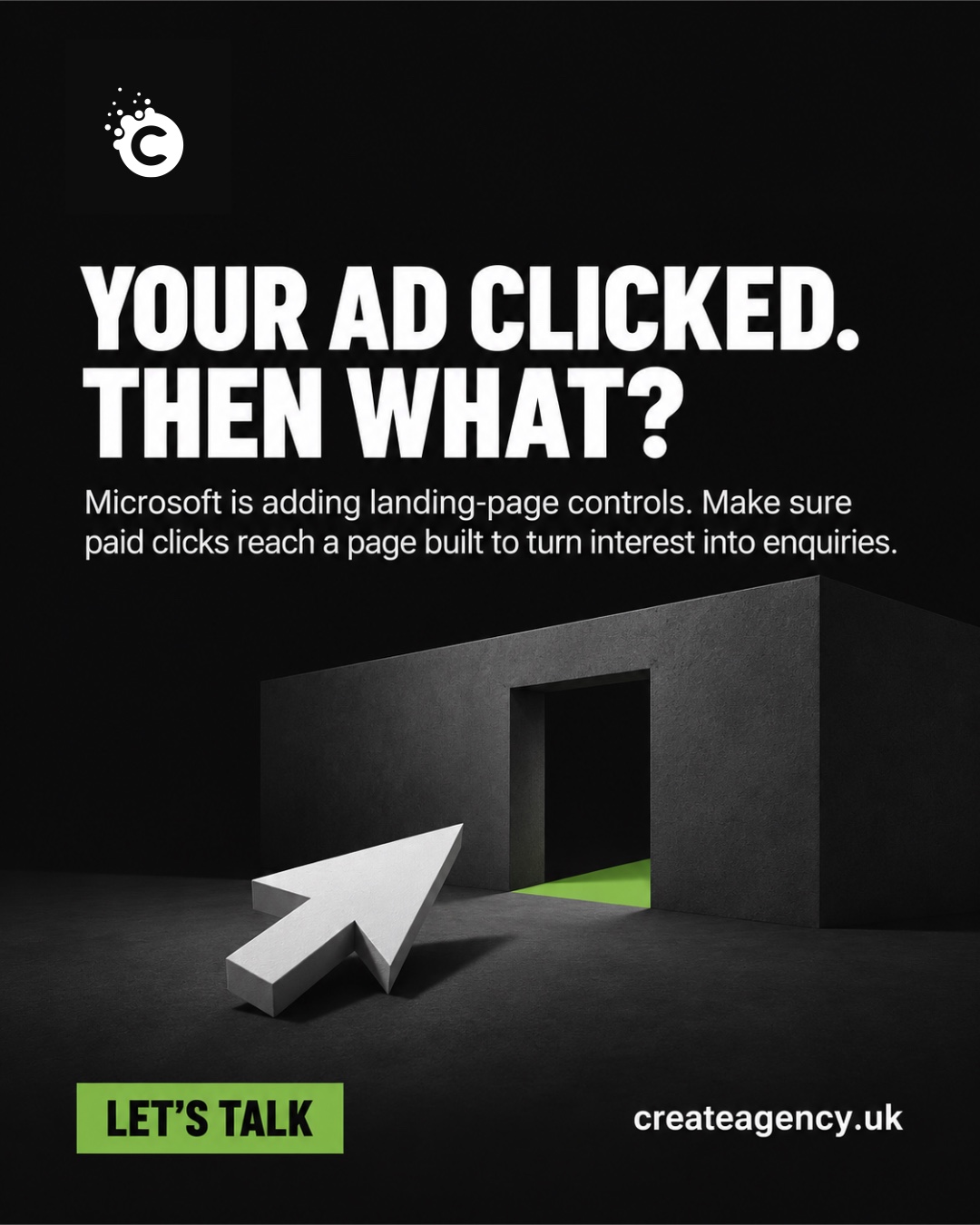
If you use Microsoft Advertising, review the pages your campaigns can send people to before increasing your budget. A relevant destination, a clear offer and a working enquiry route deserve as much attention as the advert itself.
Microsoft's 19 November 2026 announcement says URL inclusions for AI Max are rolling out. They help advertisers select website areas used for destinations, text customisation and search matching. Check your account for availability; this is not a claim that every UK or UAE account already has the feature.
Why the destination matters
An advert makes a promise. The next page needs to continue that conversation. If someone clicks for a particular service and lands on a broad homepage, they may have to work out whether you actually provide it, where you operate and how to get a price.That is a problem worth fixing before buying more traffic. A campaign setting can guide visitors towards a page. It cannot make an unclear offer convincing or repair a broken form.
This is where CREATE's website and paid advertising services meet: the campaign, page and enquiry process should be planned together.
Start with one commercially useful page
Pick a service you want more enquiries for and map the journey from the advert to the response. Write down the customer question, the promise in the advert, the page answering it and the action you want the visitor to take.For example, imagine a local garage promoting fleet servicing. Sending the visitor to a page about every service in the workshop leaves several questions unanswered. A focused fleet page could explain the vehicles handled, service area, booking process and information needed for a quote. That is an illustrative example, not a CREATE client result.
Avoid building a page for every tiny variation of a keyword. Start with a distinct customer need and an offer you can actually deliver.
Check these five things before increasing spend
- Message match. Does the opening heading answer the same need as the advert? Remove old promotions and claims that no longer apply.
- Practical detail. Can the customer find the service area, relevant availability and what happens next? For businesses serving both the UK and UAE, check country, currency and contact details on the actual destination. Do not assume one page serves both markets well.
- Mobile usability. Open the page on a phone. Check that text is readable, buttons are easy to use and images do not get in the way of the enquiry.
- Enquiry delivery. Submit a clearly labelled test. Confirm that it reaches the right person and receives the expected acknowledgement. A success message on the page alone does not prove delivery.
- Measurement. Separate completed enquiries from button clicks. Check that duplicate events are not making the campaign look more successful than it is.
Judge the change by useful enquiries
Record the starting position before making changes: spend, completed enquiries, qualified enquiries and bookings or sales where you can reliably connect them. Note the date and what changed.An illustrative campaign spending £300 for ten enquiries has a £30 cost per enquiry. If only two are suitable, the cost per qualified enquiry is £150. The second number is often more useful when deciding whether to increase the budget. Neither figure is a forecast or a benchmark.
Give the test enough time and volume for your business before judging it. Where enquiries are infrequent, a few days of movement can be misleading. Keep other major changes limited so you have a reasonable chance of understanding what helped.
What to do this week
Choose one important campaign and inspect its destination. Have the person answering enquiries test the journey with you. Fix obvious mismatches, confirm tracking and review any available URL controls with your campaign manager.The commercial opportunity is straightforward: make the journey from paid attention to a genuine conversation easier to complete. There is no need to chase every new advertising feature to do that.
Talk to CREATE about your ads and landing pages.
Source: Microsoft Advertising, 19 November 2026. Checked 20 November 2026. Practical recommendations and examples above are CREATE's analysis, not Microsoft's performance promises.