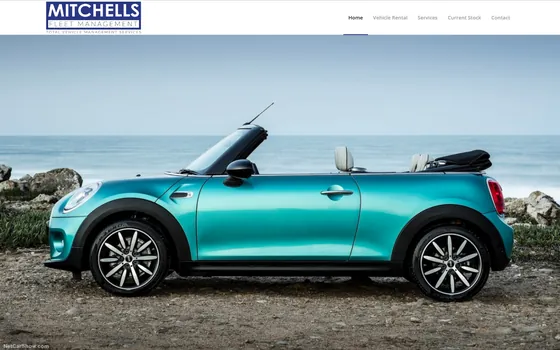
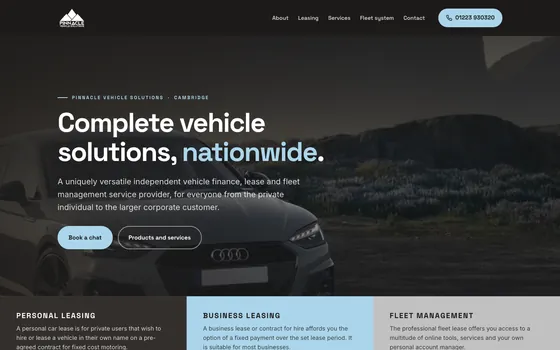
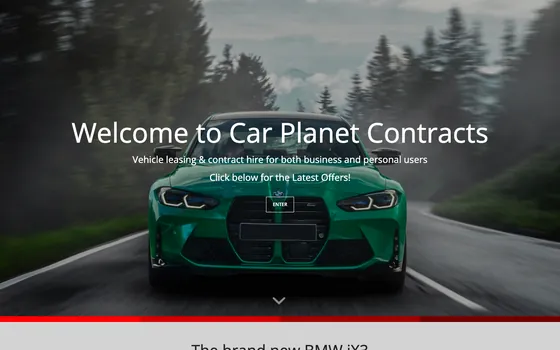
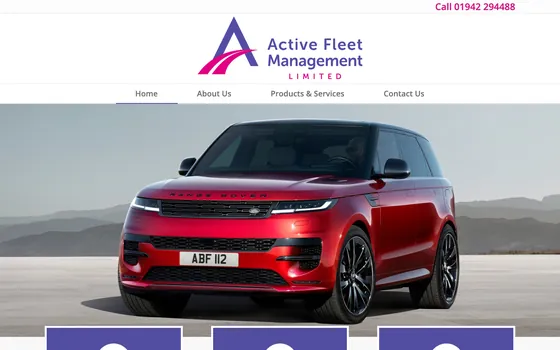
Eleven of the businesses CREATE builds for move, hire, sell, service or manage vehicles. It is the single biggest thing we do, more than any one town we work in.
Workshops, hire fleets, leasing brokers, tyre call-outs, accident hire, HGV repair, vehicle sales. Different businesses, but the same handful of problems keep turning up: a buyer who is either in a hurry or doing careful due diligence, stock and vehicle data that has to stay current without someone retyping it, and a phone number that has to be findable in seconds on a bad signal.
The measure we care about is enquiries. A site that wins design awards and generates nothing is a failure, and we would rather say so at the quote stage than at the review meeting.
Neither of these is a client site. Both are demonstration builds, made in-house so that a vehicle business can see the harder end of this working before committing budget to it.
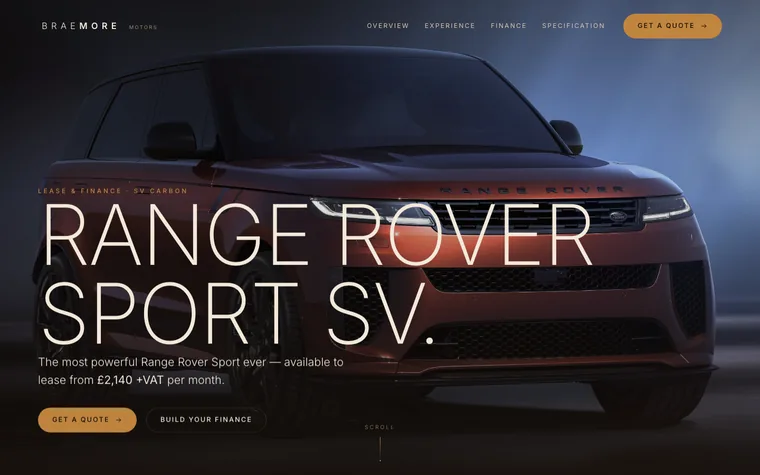
Braemore Motors is a demonstration build, not a client site, made in-house to show what a single-vehicle launch page can do when there is no compromise on it.
The whole page is scroll-driven: the hero scrubs as you move, full-screen scenes dissolve into one another, a strip of detail shots glides sideways, and the film starts small at the back before zooming to full width. Underneath it is a working finance calculator that recalculates against agreement type, term, initial rental and mileage: business contract hire, personal contract hire and finance lease, with the balloon payment appearing only where it applies.
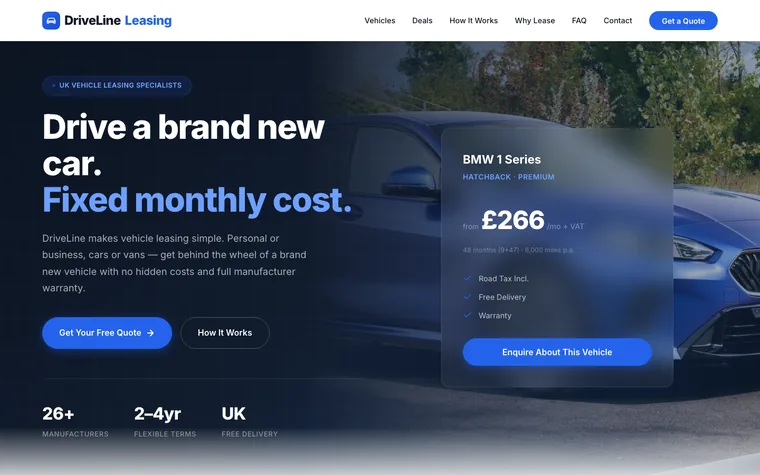
DriveLine Leasing answers the question every broker asks: who changes the offers? Here, they do.
Offers are added, edited, reordered, photographed and priced from a password-protected admin, and the public page updates itself within seconds, no developer, no ticket, no waiting for someone to be free. The client can write their own content sections too, and pick images from a library of everything they have already uploaded. Everything else (the design, the layout, the structure) stays locked, so it cannot be pulled out of shape.
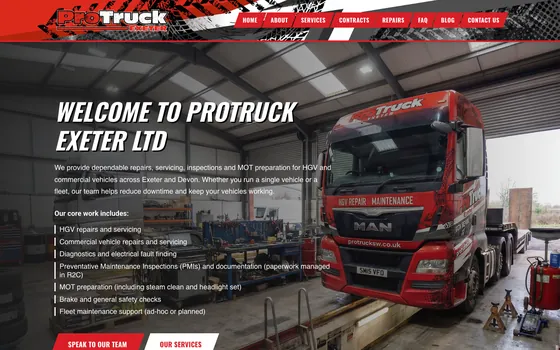
Every one of these is a live site for a real business. No stock screenshots, no “representative examples”: click through and check.
Built for operators with a vehicle off the road. Phone number, location and what you can actually fix, first, not a carousel.
Visit the site ›
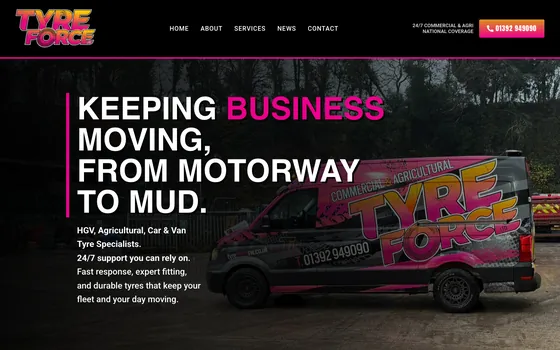
A call-out business where speed is the product. Built for someone ringing at two in the morning, at the roadside, on a bad connection.
Visit the site ›
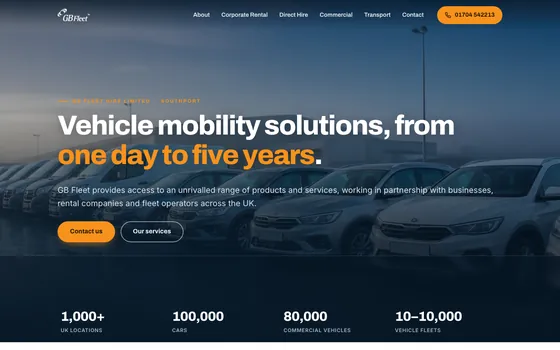
Fleet work is a long sales cycle with a cautious buyer. The site has to answer the questions a fleet manager asks before they will pick up the phone.
Visit the site ›
A workshop site that has to make it obvious what is serviced, where, and how quickly, without wading through it.
Visit the site ›
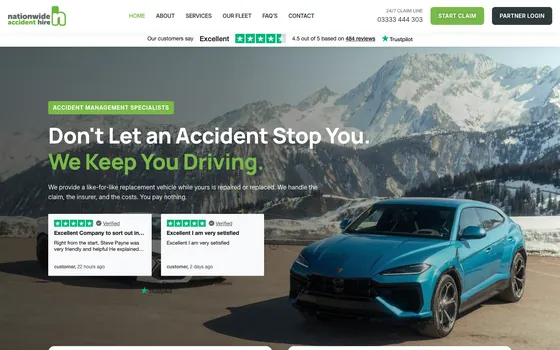
Accident hire is an urgent, stressful search. Clear routes to a person, fast, on a phone.
Visit the site ›
Fleet management sells on process and reliability. The site is built to make both legible to a buyer comparing suppliers.
Visit the site ›
A full-service vehicle business where the job is making a broad offer easy to navigate rather than overwhelming.
Visit the site ›
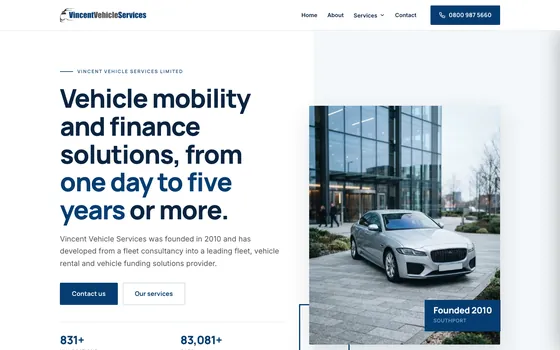
Leasing is a comparison purchase. The site has to make the numbers and the terms plain rather than hiding them behind an enquiry form.
Visit the site ›
Built around the questions an operator has about cost, compliance and downtime.
Visit the site ›
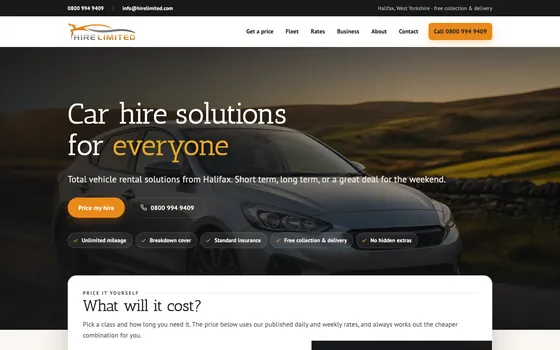
A hire business that now prices itself on the page, pick a class and how long you need it, and the site works out whether the daily or the weekly rate is cheaper.
Visit the site ›
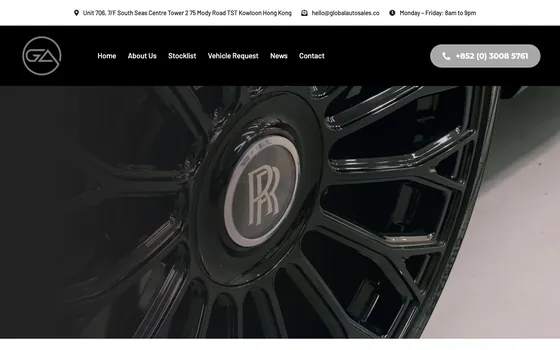
International vehicle sales, a site that has to work for buyers in several markets at once.
Visit the site ›The first vehicle site you build, you learn the trade. By the eleventh you know where the projects actually stall, and it is rarely the design. It is the vehicle data, the depot pages, the compliance content nobody wants to write, and the photography that never arrives.
It also changes what you argue for. Most of these businesses do not need a bigger website; they need a faster one with fewer places to get lost. Two of the builds on this page are deliberately smaller than what the client first asked for.
And the search side is specific to the sector. “Tyres near me” at 2am and “fleet management provider” on a Tuesday afternoon are not the same job, one is a map pack and a phone number, the other is a long read and a comparison. We build for whichever one actually pays you.
This is the biggest single vertical we work in, and the pattern across it is consistent: the website is a qualification tool, not a shop window. Whether it is fleet management, contract hire, accident management, vehicle sales or commercial tyres, the visitor is trying to work out in about thirty seconds whether you handle their kind of vehicle, in their area, at their scale.
That means the specifics have to be at the top. Cars or commercials, the weight classes covered, whether you do mobile or workshop, hours and out of hours, geographic coverage, and whether you deal with businesses, retail customers or both. Fleet buyers in particular are comparing three or four suppliers on the same afternoon, and the one that answers fastest usually gets the call.
The 24/7 operators have an extra problem worth naming. If half your work arrives at two in the morning from somebody standing next to a broken down vehicle, the site has to be built for that moment: a phone number that is tappable, no cookie wall in the way, and a page that loads on a bad signal on a hard shoulder. That is a build decision, not a design preference.
The motor trade splits into local-urgent and national-considered, and most operators do both without realising the searches are completely different.
Local and urgent is breakdown, tyres, recovery and repair. That is a map pack and Google Business Profile job first and a website job second, and it is won on proximity, hours, reviews and whether your profile says you are open right now.
National and considered is contract hire, fleet management, vehicle sourcing and accident management. There is no geographic limit on any of that, and it is won on pages that name the service precisely rather than listing everything a motor business could theoretically do.
The vehicles themselves are search terms. Makes, models, weight classes, tyre sizes and fitment types all get typed in, and a site that structures that information properly picks up a long tail of high-intent traffic that competitors leave on the table.
AI answers increasingly handle the "who can do X near me" question, and they draw on sites that state coverage, hours and capability as clear facts rather than marketing copy.
Landing pages start from £500. Brochure sites, e-commerce and bespoke platforms are quoted to scope, because pretending otherwise produces a number that changes the moment we understand the job. You get a fixed price before anything starts, and it does not move unless you ask for something new.
On timescales: a simple page can be turned around in 24 to 48 hours, most brochure sites go live in three to six weeks, and e-commerce or custom builds run six to twelve weeks. The variable is almost never us. It is how quickly copy, photography and technical detail come back, and we will tell you at the start which of those sits on your side of the line.
We are founder-led, so the person who quotes the job is the person who builds it. Nothing is subcontracted, and you are not paying for an account manager to relay messages between you and the person doing the work.
No. The vehicle businesses we build for are in Southport, Manchester, Glasgow, Cambridge, Skipton, Ormskirk, Exeter and Hong Kong. Almost none of this work is local to us, because the sector matters more than the postcode.
Because the buyer is different. A fleet manager comparing suppliers wants process, compliance and cost. Someone with a vehicle off the road wants a phone number in two seconds. Most agency templates are built for neither.
Usually the reason these projects stall: vehicle data, stock feeds, DVSA and compliance pages, multi-depot listings. We build those rather than leaving them as a phase two that never happens.
A single page can be turned around in 24 to 48 hours. Most brochure sites go live in three to six weeks, and stock or booking systems run six to twelve weeks. The variable is almost never us; it is how fast photography and vehicle data come back.
Dom does. CREATE is founder-led, so the person who quotes the job builds it. No account managers, no junior team learning on your project, no subcontracting.
Reviews from Google and Trustpilot, quoted as written. There are more on our reviews page.
“Exceptional service - dedicated & responsive to brief It’s taken me years to find someone that understand my business to be able to do a website justice. Thank you Dom !…”Jo Storrvia Google
“Excellent from start to finish. The website was done before I even knew about it. All the info processed onto the site was seamless, any little tweaks got done straight away. Dom is helpful, friendly and very professional from start to finish.”Mark Stantonvia Google
“Well what can I say, in 24 hours Create Agency rebuilt my website, sorted the SEO, fixed my emails. Pretty much did everything that my current provider wasn’t doing but was happy to take my money. Brilliant service, can’t recommend enough, thanks again for such a fantastic service. Steve”Steven Leggettvia Trustpilot
“Create Web Design did an outstanding job on our website. Professional, responsive, and genuinely creative. Dom understood exactly what we needed and delivered ahead of schedule. Communication was excellent throughout. Highly recommend if you want a team that actually cares about the result, great work.”Ian Prattvia Google
No pitch deck and no account manager, you speak to the person who will do the work.