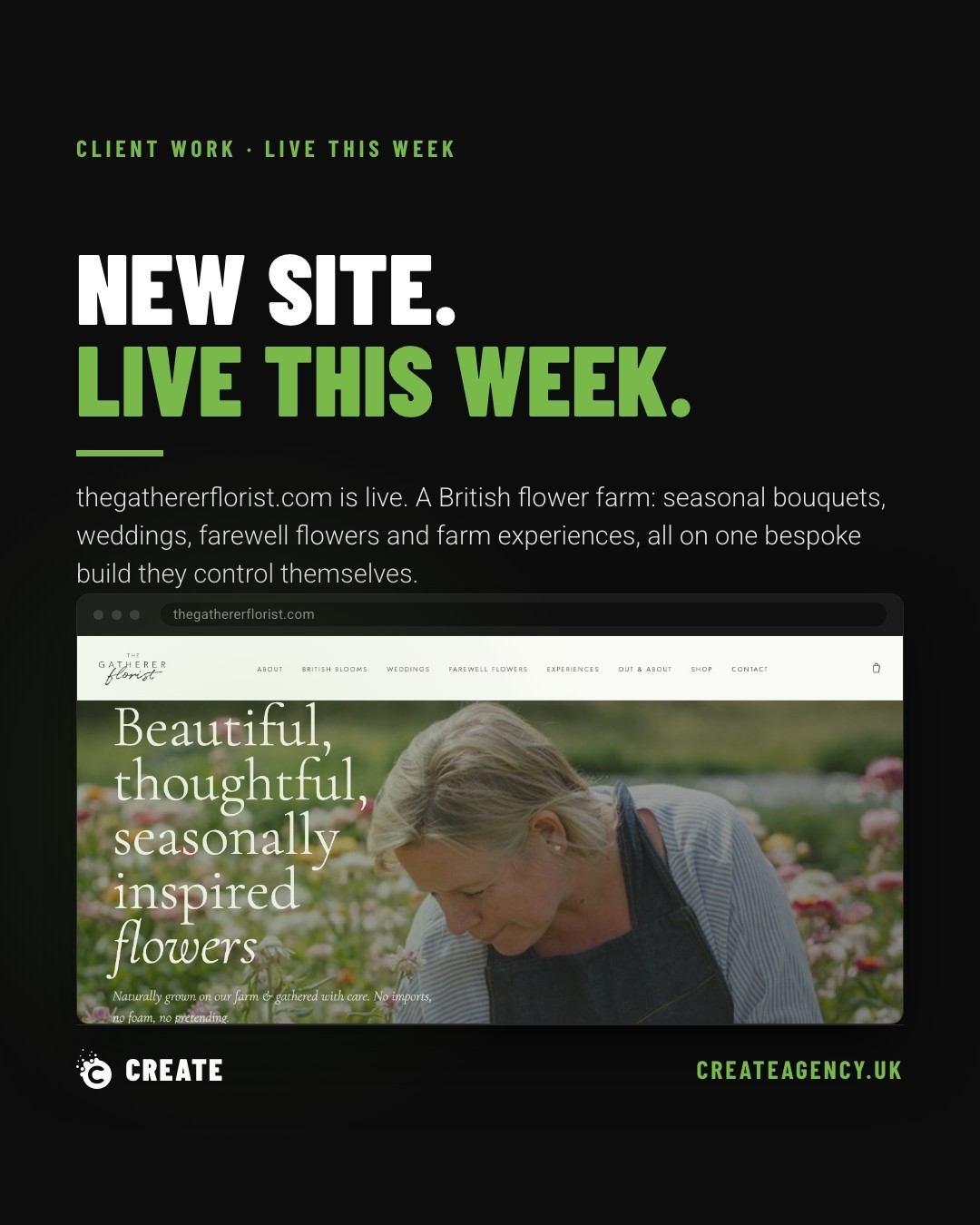
The Gatherer Florist is live this week at thegathererflorist.com. On the surface it looks like a website launch. Underneath it is a case study in why templated platforms struggle the moment a business is more complicated than the box they were designed for.
The Gatherer isn't a florist that buys in stock and arranges it nicely. It's a working flower farm. The flowers are grown on site, not flown in from wherever is cheapest that week. That distinction matters commercially and it matters to customers who care where their flowers come from, but it's exactly the kind of nuance that gets lost when a business is forced into a generic online shop template.
One Business, Five Reasons To Visit
The brief wasn't really "build a florist website". It was "build a site that explains a flower farm with five genuinely different offers, without any of them drowning out the others".
Those five are seasonal bouquets and posies, weddings, farewell flowers, farm experiences (pick your own, tours, private parties), and market and show appearances, on top of the online shop itself. Each of those is a different customer, searching for a different thing, often at a different time of year.
A generic florist site assumes one job: sell flowers online. Try to bolt weddings, farewell flowers, farm tours and market dates onto that structure and something always ends up buried on page three of a menu nobody clicks. The old setup never got this across properly, which was the whole reason for starting again.
The job for the new site was making each of those five reasons obvious within a few seconds of landing, without the page turning into a cluttered mess of competing calls to action. That's an information architecture problem as much as a design one, and it's where a lot of small business sites quietly fail.
Why This Wasn't Built On Shopify Or WordPress
There's a reasonable question here: why not just use Shopify with a nice theme, or WordPress with a florist plugin? Plenty of agencies would have, and plenty of florists run perfectly fine on exactly that setup.
For The Gatherer, it didn't fit. A themed platform gives a business someone else's structure and asks them to squeeze their offer into it. Five distinct customer journeys, a seasonal farm calendar, and an events and experiences side don't squeeze in neatly. We built this one bespoke instead, which meant the structure could be shaped around the farm, not the other way round.
Bespoke also meant we could integrate SumUp payments directly into the site itself, rather than routing customers off to a third-party checkout rented from a platform. That sounds like a small technical detail. It isn't.
Owning The Platform Instead Of Renting It
Shopify and similar platforms come with a monthly fee and, in many cases, a commission on orders that were never going to be optional anyway. WordPress plugins come with their own tax: constant updates, security patches, and the slow creep of a dozen add-ons that all need to keep talking to each other without breaking the site.
With a bespoke build and a direct SumUp integration, The Gatherer Florist doesn't pay a platform fee for the privilege of taking payment. There's no commission skimmed off every bouquet, wedding deposit or farm experience booking. There's no plugin update to schedule around, and no third-party roadmap dictating when a feature arrives or whether it arrives at all.```
That's not a minor cost saving, it's a structural difference. The site, the payments, and the customer data belong to the business. An independent flower farm ends up with an independent website and its own direct relationship with its own customers, rather than a shopfront built on land it doesn't own.
What This Means For Other Independent Businesses
The Gatherer isn't unusual in having more than one thing to sell. Most independent businesses with any history behind them end up with a main product, a few related services, some seasonal or event work, and a physical presence somewhere too. The mistake is assuming a template built for "sell one type of product online" can flex to cover all of that convincingly.
It rarely can, not without the site starting to feel like five separate businesses stapled together. The alternative is to build the site around the actual shape of the business from the start, including how payments, bookings and content are handled, rather than retrofitting a plugin every time a new offer gets added.
If a business has outgrown its website, or never had one that reflected what it actually does, that's a conversation worth having early rather than after another season of customers landing on a page that only tells half the story. We work through exactly this kind of problem with businesses across every sector, and it's the sort of project best scoped properly from day one, which is easiest to do over a call.