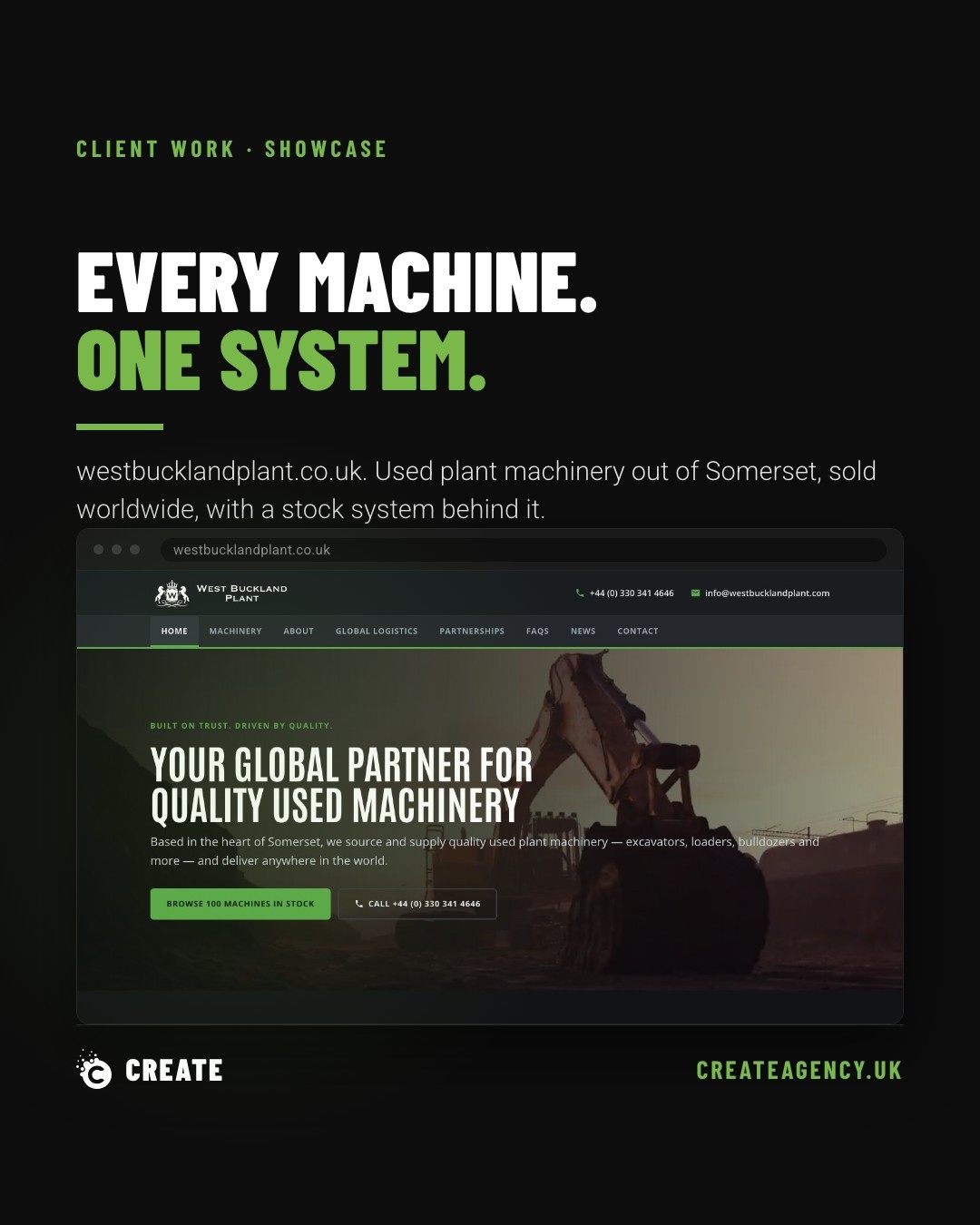
Used plant machinery is a global trade run on local relationships and dog-eared spec sheets. West Buckland Plant, based in Somerset, source and supply excavators, loaders and bulldozers to buyers anywhere in the world. The machines are heavy, expensive, and move fast. Their website had to keep up.
Most dealer sites fail in the same quiet way. A machine sells, somebody forgets to take it down, and a buyer in another country enquires about an excavator that left the yard three weeks ago. Multiply that across a hundred machines and the website stops being an asset and starts being a liability, one nobody has time to fix because they are too busy actually selling plant.
We built West Buckland Plant's site to solve that problem at the root, rather than papering over it with reminders and spreadsheets.
The Problem With Managing Stock By Hand
Every machine on a dealer site needs its own page: photographs, specification, condition, price, availability. Done manually, that is a full day's work before a single machine is even listed properly. Then it needs doing again the moment the machine sells, and again when a new one arrives.
In a business moving dozens of machines a year, that workload does not shrink, it compounds. Someone ends up as the unofficial website administrator on top of their actual job, and the first thing to slip is the thing customers see first: whether a listing is still live.
We see this across the heavy equipment and specialist machinery trade generally. The stock changes constantly. The website, built as a one-off project rather than an ongoing tool, cannot keep pace without someone babysitting it daily.
Building The Site Around The Stock, Not The Other Way Round
For West Buckland Plant, we flipped the usual order of priorities. Instead of designing pages and then figuring out how to slot machines into them, we built the site so a machine only needs entering once.
Add an excavator, with its photos and specification, and it appears everywhere it should: the main listings page, the relevant category, any search filters, and wherever else the site structure calls for it. Sell it, mark it gone, and it disappears from every one of those places automatically, including the pages nobody remembers exist.
That single change removes the entire category of error that kills trust on a dealer site: the stale listing. A buyer browsing from overseas, who may never set foot in Somerset before wiring a deposit, needs to believe that what they see is what is actually available. One dead listing is enough to make them question the rest.
Why This Matters More For International Buyers
West Buckland Plant ship machinery anywhere in the world, which means a large share of their enquiries come from people who cannot simply drive over and look. The website carries more weight than it would for a purely local trader. It has to do the job a showroom visit would normally do: show the machine accurately, show it is genuinely available, and make specification easy to check before anyone picks up the phone.```
For that reason, accuracy is not a nice-to-have feature, it is the foundation the entire sales process stands on. A site that occasionally shows ghost stock is actively working against the sales team, generating enquiries that go nowhere and wasting everyone's time.
A Website That Runs Part Of The Business
There is a real difference between a website that needs maintaining and one that does the maintaining. Most dealer sites are the former: a static shopfront that someone has to keep patched up manually, forever, or it starts lying by omission.
What we built for West Buckland Plant behaves more like a piece of operational infrastructure. Stock goes in once, correctly, and the system takes care of where it needs to appear and when it needs to vanish. That is less a website project and more a small piece of business automation wearing a website's clothes.
It is also, frankly, the only approach that scales. A hundred machines managed by hand is a job. A hundred machines managed by a system that understands the stock is just Tuesday.
If stock, inventory, or a constantly changing catalogue sits at the heart of a business, the website should be built to manage that reality rather than fight it. That is the kind of problem we like solving. Take a look at our portfolio for more examples, or book a call to talk through what a stock-led build could look like for yours.