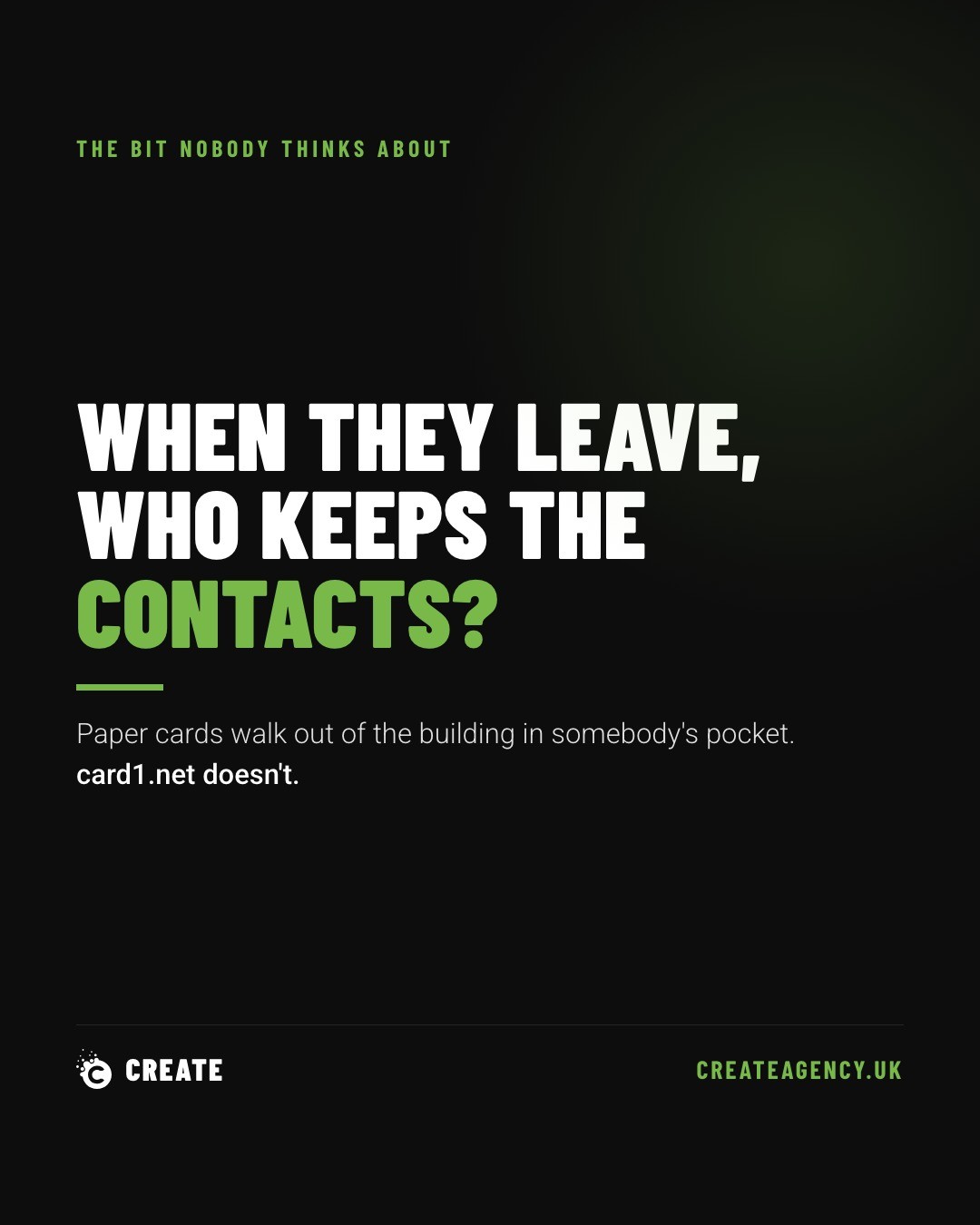
A member of staff spends three years building relationships. Trade shows, site visits, the conversation after a job that turns into the next job. Then they resign, and every one of those contacts leaves with them, because the only record was a stack of business cards in a drawer and a personal phone.
This is a problem most businesses only notice once, which is usually once too often. It is also entirely avoidable, and the fix has nothing to do with tighter contracts or exit interviews. It is about who owns the contact in the first place.
The Business Card Was Never Really a Business Asset
A paper card, or a phone number saved under someone's own name, has always belonged to the person holding it, not the company that paid for the trade show stand or the fuel to get to the site visit. That has been true for decades and nobody thought much of it, because there was no practical alternative.
Digital business cards change that. A platform like Card1 lets a company hold the contacts its team collects centrally, rather than scattered across individual phones and drawers. The introductions still happen the same way, at the same events, through the same conversations. What changes is who keeps the record when the conversation is over.
What Happens When Someone Leaves
The real test of this isn't day-to-day convenience, it's the moment a team member hands in their notice. With contacts held on personal devices, that moment is when years of relationship-building quietly disappear. Nobody hands over a spreadsheet of who they met at a conference in 2022.
With a company-owned digital card, the card itself gets reassigned. The relationships stay attached to the business, not the individual who happened to be holding the phone. New starters can be handed an existing card and existing contacts rather than starting from nothing, and departing staff take their skills with them but leave the network behind, which is exactly how it should work.
The Smaller, Everyday Advantages
Beyond the succession problem, there are practical reasons digital cards outperform paper ones, and most of them come down to accuracy. Update a phone number or job title once, and it updates everywhere, including the version someone already saved in their Apple or Google Wallet months ago. No reprinting a box of 500 cards because someone got a promotion.
They also work without friction. There is nothing to install and no app the other person needs to download; a card works on any phone, which matters when the person you are handing it to is standing in front of you at a trade show and has thirty seconds before the next conversation starts.
The Point That Actually Matters to an Owner
All of the above is useful, but the reason this is worth taking seriously isn't convenience. It's cost. Every introduction a team member makes on the company's behalf was paid for, whether that's the stand fee, the travel, the wages for the day, or simply the time it took to build trust with a client over several site visits.
When that contact lives in a personal phone, the business has paid for something it never actually owns. When it lives in a system the company controls, the investment stays where it was made. That is a straightforward commercial argument, not a nice-to-have.
We've seen plenty of businesses tighten up their websites, their SEO, their paid ad spend, all while leaving something as basic as their contact network exposed to whoever happens to be holding the phone that day. If digital infrastructure is worth getting right elsewhere in the business, it is worth getting right here too. If it would help to talk through how digital tools like this fit into the rest of your setup, get in touch and book a call.