Most businesses can tell you they have a website backup. Far fewer can tell you the last time anyone actually restored it. That gap, between having a backup and knowing it works, is where a lot of very confident-sounding IT setups quietly fall apart.
A backup nobody has tested is not really a backup. It is an assumption with a filename attached to it. It might be missing files, it might be backing up the wrong database, it might have been failing silently for six months while every automated email said "success". Nobody finds out until the day they actually need it, which is precisely the worst possible day to discover a problem.
Why Untested Backups Are a Gamble, Not a Safety Net
Backing up a website is not difficult. Most hosting platforms and content management systems will do it automatically, on a schedule, without anyone lifting a finger. That ease is exactly the problem. It is simple to switch on, easy to forget about, and rarely checked once it is running.
A backup file sitting untouched for a year tells you nothing about whether it will actually restore a working site. Databases change structure. Plugins get updated. File paths move. A backup taken today might not sit happily on the server configuration you are running in twelve months' time, and the only way to know is to try putting it back.
We have seen businesses discover, after a hack or a failed update, that their "backup" was a single file from eighteen months ago, or covered the images but not the database, or simply did not exist despite years of assurances that it did. By then, it is too late to fix the process. It is only useful for finding out how much was lost.
How We Handle a Website Replacement
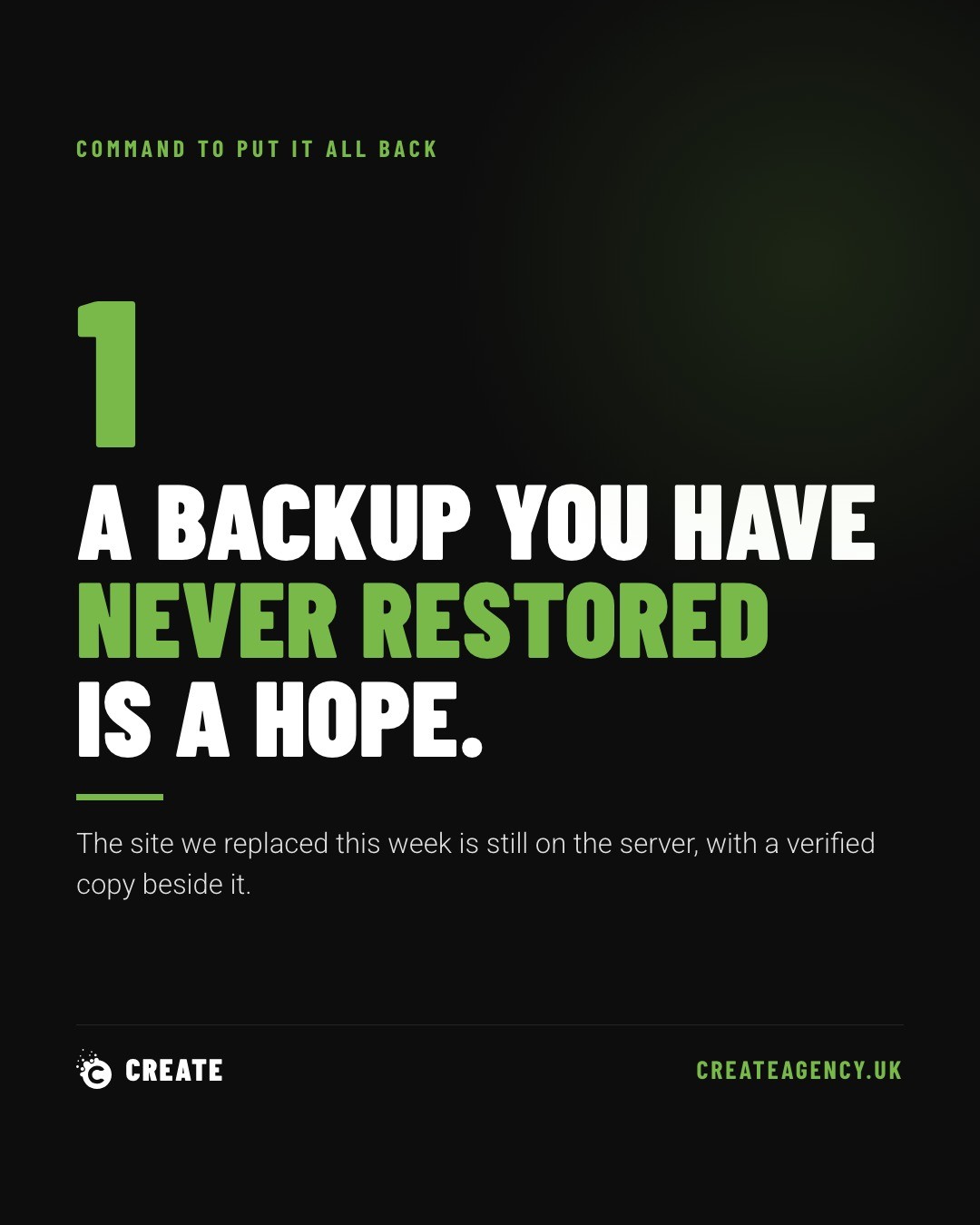
When we replace a client's site, the old version does not get deleted. It gets moved aside, on the same server, with a separately stored and verified copy of both the files and the database. If something needs rolling back, it is one command, not a frantic afternoon trying to reconstruct a site from memory and screenshots.
This is not about distrusting the new build. It is about making the cost of being wrong as low as possible. Rollback plans are cheap to arrange in advance and expensive, sometimes impossible, to arrange in a panic. We would rather spend twenty minutes setting up a safety net we never touch than spend a weekend rebuilding something that should never have been at risk.
The Half-Hour Check Worth Doing This Week
Most site owners do not need a new backup system. They need to check that the one they already have actually works. That means finding out three things: where the backups are stored, how recent the most recent one is, and whether anyone has ever restored one to confirm it is complete.
If the answer to any of those is "not sure", that uncertainty is the actual risk, more than any specific technical flaw. It costs very little to resolve. Ask whoever manages the hosting to show a recent backup, then ask them to restore it somewhere separate, a staging environment or a spare subdomain, and check the site that comes back matches what is live now.
For businesses running e-commerce, this matters even more. A backup that misses recent orders or product changes is not just inconvenient, it is a direct hit to revenue and customer trust if something goes wrong and the fallback position turns out to be six weeks out of date.
Building Recovery Into the Process, Not Bolting It On Afterwards
The businesses that handle this well do not treat backups as an insurance policy bought once and forgotten. They treat rollback as a normal part of any change to the site, whether that is a plugin update, a redesign, or a full rebuild. Before anything changes, there is a known-good version sitting somewhere safe, and someone has actually confirmed it works.
That habit costs almost nothing to maintain once it is in place. It is the difference between a website issue being a minor inconvenience fixed in minutes and a full-blown crisis that eats a week and a client's patience.
If it has been a while since anyone checked how your website's backups actually work, or whether they exist at all, it is worth putting half an hour aside this week to find out. We build this kind of resilience into every project we deliver, and if it would help to have a second pair of eyes on your current setup, get in touch and book a call.