There is a particular kind of business that earns its reputation through sheer performance: lorries moving before dawn, materials delivered on spec, jobs won through trust built over years on site. The trouble is, the marketing rarely keeps pace with the operation. It sits quietly in the background looking apologetic, when it should be doing exactly what the business does: making an impression.
That gap between what a company actually is and how it presents itself publicly costs real money. Not in some abstract brand-equity sense, but in tenders not won, calls not made, and prospects quietly choosing a competitor whose website looked more credible.
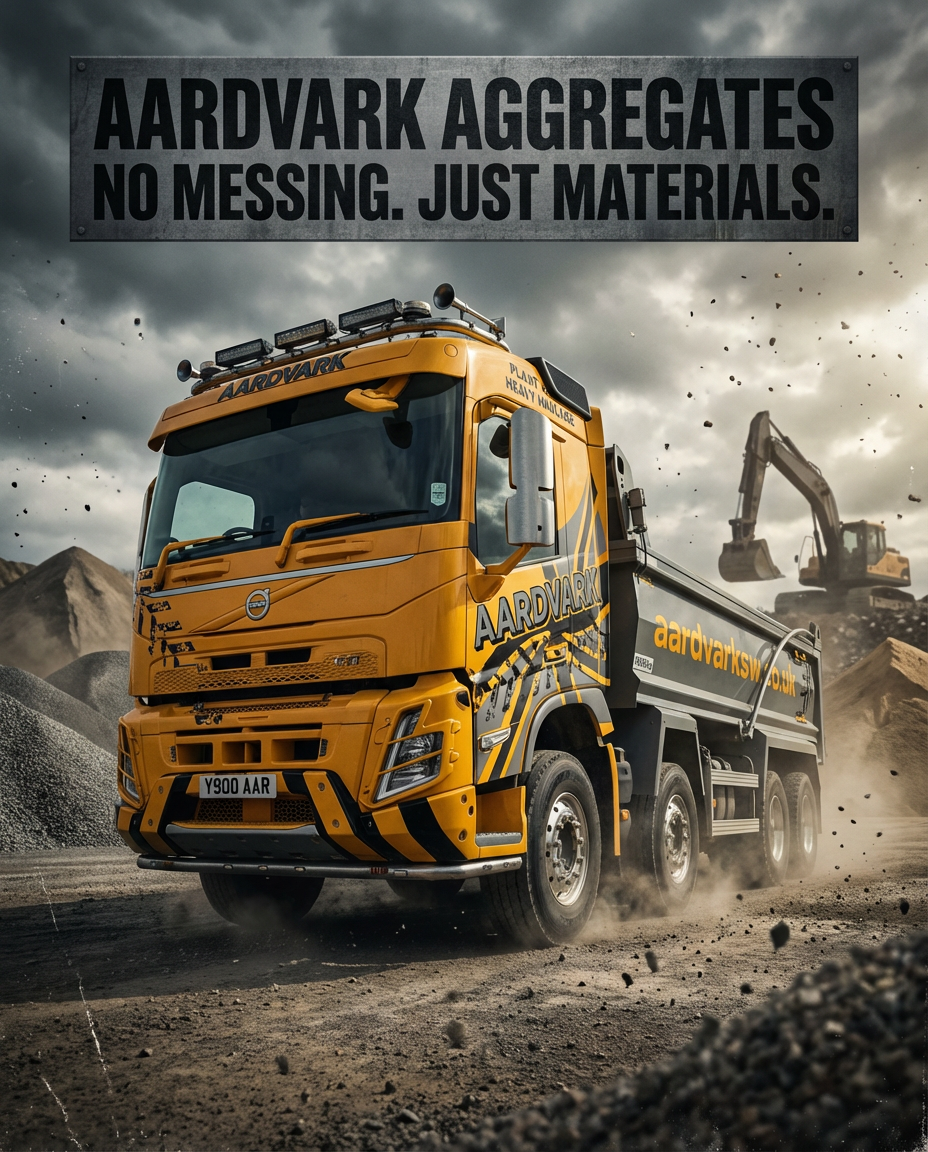
We have been working with Aardvark (specialists in aggregates and haulage) to close exactly that gap. The work is ongoing, and it has reminded us of something we see repeatedly in construction, civil engineering, and logistics: the businesses doing the most serious work are often the least serious about their marketing.
The Brand Is Being Built Whether You Intend It or Not
Every lorry on a job site carries your name. Every quote you send, every social post, every time someone Googles the business: those are brand touchpoints. The question is not whether you are building a brand. You are. The question is whether you are building it deliberately or leaving it to chance.
For Aardvark, we started by looking at what the business actually feels like (the scale, the pace, the no-nonsense delivery), and making sure the marketing reflects that honestly. Bold visuals. Messaging that does not hedge. A visual identity that holds together across formats and does not fall apart when you scale it up to a hoarding or down to a social graphic.
Consistency matters here more than most sectors appreciate. When a potential client sees the same confident, coherent brand across your vehicles, your website, and your social presence, they draw a reasonable conclusion: this company has its act together.
Campaigns That Sell the Outcome, Not the Process
One of the most common mistakes we see in industrial and trade marketing is content that describes the service in exhaustive detail without ever communicating what the client actually gets. How many tonnes moved. How quickly. What problem solved.
The buyer does not want a brochure about your fleet. They want confidence that the job will be done, on time, without drama. Good campaign thinking leads with that. Taglines should sound like the business feels: direct, capable, unhurried. The visual language should reinforce it.
For Aardvark, that means campaign ideas built around outcomes and authority, not feature lists. It means content that earns attention rather than demanding it.
Why the Construction and Haulage Sectors Are Worth Getting Right
These are not low-margin cottage industries. Aggregates, earthworks, haulage, and civil engineering involve significant contract values, long client relationships, and repeat business that compounds over years. The return on serious marketing investment in these sectors is substantial precisely because so few operators bother.
If your competitors are still relying on word of mouth and a website built in 2014, putting genuine resource into your brand and campaigns is not vanity; it is a commercial advantage. It changes who calls you, what they expect to pay, and how quickly they make a decision.
When your marketing looks like you mean business, people assume the service does too. That assumption is a shortcut to trust, and trust is what closes contracts.
What Serious Industrial Marketing Actually Looks Like
It is not about production values for their own sake. Expensive photography does not fix weak strategy. What matters is coherence: does every piece of communication reinforce the same impression of the business?
For a business like Aardvark, that means visual assets that feel as substantial as the operation. Messaging that respects the intelligence of the buyer. Social content that treats the audience as professionals rather than scrollers to be entertained. And campaign thinking that connects the marketing activity to actual commercial objectives: more enquiries, better-fit clients, stronger positioning in a competitive regional market.
None of this is complicated in principle. It requires honest thinking about what the business is, who it is for, and what those people need to see before they pick up the phone.
If your business operates at a level your marketing has not caught up with yet, that is a solvable problem. Take a look at our branding and marketing services to see how we approach it, or book a call if you would rather talk it through directly.