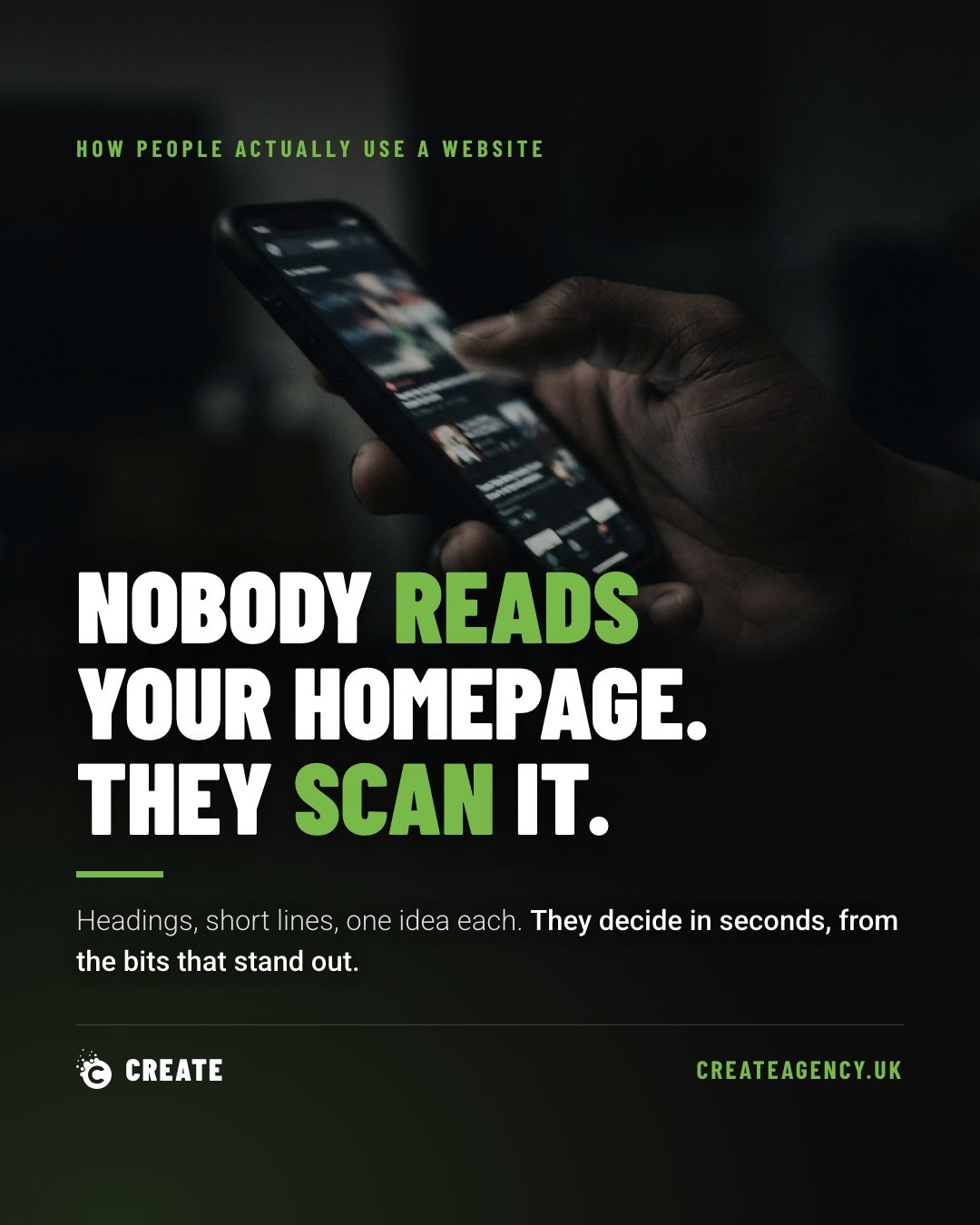
Nobody reads a website. Not properly, not from top to bottom, not in the order the designer intended. People scan, they skip, and they decide whether to stay within seconds. The paragraph a client agonised over for a week is often doing less work than the six words sitting above it.
We see this constantly in audits. A homepage with beautifully crafted copy, three screens deep, and the visitor still has no idea what the business actually does. By the time they find out, they have already left.
This is not an argument for writing less. It is an argument for writing differently, shaped for how people actually behave on a page rather than how we wish they behaved.
Headings Should Say Something, Not Label Something
Most websites use headings as filing labels. "Our Services." "About Us." "Why Choose Us." These tell a scanner nothing because they describe a category rather than make a claim.
A heading that says something gives the scanner a reason to keep reading. "We build websites that convert, not just impress" does more work than "Our Services" ever will. If a heading could sit above any competitor's page unchanged, it is not pulling its weight.
This matters more than most businesses realise, because headings are often the only part of a page a visitor reads properly. Everything else is scanned around them.
Five Questions, Answered in Order
We test every page we build against a simple sequence. Can a visitor, moving fast and reading almost nothing, answer these five questions without hunting:
What do you do. Is this for me. Can I trust you. Roughly what does it cost. What do I do next.
Most sites fail this test badly. The first question often does not get answered until the third screen. The fourth question, pricing, frequently does not get answered at all, which pushes genuinely interested visitors towards a competitor who was willing to say a number.
The order matters as much as the answers. A visitor who cannot work out whether a service is for them has no reason to care whether it is trustworthy. Trust signals placed before relevance is established are wasted.
Short Lines, One Idea Each
Dense paragraphs hide the sentence that actually matters. If the important line is the third sentence in a block of five, most scanners never reach it.
The fix is not clever. Break the block up. Give the important sentence its own line. Let it breathe. One idea per line forces clarity, because there is nowhere for vague thinking to hide once it is isolated on the page.
This also makes copy easier to write well. A paragraph trying to do three jobs at once usually does all three badly. Three short lines, each doing one job, tend to beat it on every measure that matters: clarity, conversion, and how long someone actually stays on the page.
Write for the Scanner, Build in Room for the Reader
The scanner and the slow reader are not different audiences requiring different pages. They are the same visitor at different points in their decision. Good structure serves both without compromise.
The scanner needs headings that commit to a point, short lines, and the five questions answered early and in order. The reader who wants detail needs that detail to exist, just not blocking the surface. Put it below the fold, in a secondary section, or behind a clear link, so it is there for whoever wants it without slowing down everyone else.
This is a copywriting problem before it is a design problem, but the two are rarely separated cleanly in practice. A beautifully designed page with buried copy still loses the scanner. A clearly structured page with weak visual hierarchy makes the scanner work harder than they will tolerate. The two need to be solved together.
Getting the Shape Right
We have rebuilt enough underperforming websites to know the pattern repeats. The words are often fine. The shape is wrong. Businesses rewrite the same paragraph four times chasing better phrasing when the actual fix is structural: shorter lines, bolder headings, and the five questions answered in the first screen, not the third.
If a site is getting traffic but not enquiries, this is usually where to look first. We help businesses across Devon, Dubai, and beyond rework their web copy and structure so visitors get the point fast, whether they are scanning or settling in to read. If that sounds like a conversation worth having, book a call and we will take a proper look at what your pages are actually saying.