Most e-commerce businesses never ask whether they could leave their platform. They ask whether they like it, whether it is fast enough, whether support answers the phone. The question that actually matters is simpler and far more uncomfortable: if the price doubled tomorrow, could the business walk away with everything it owns intact?
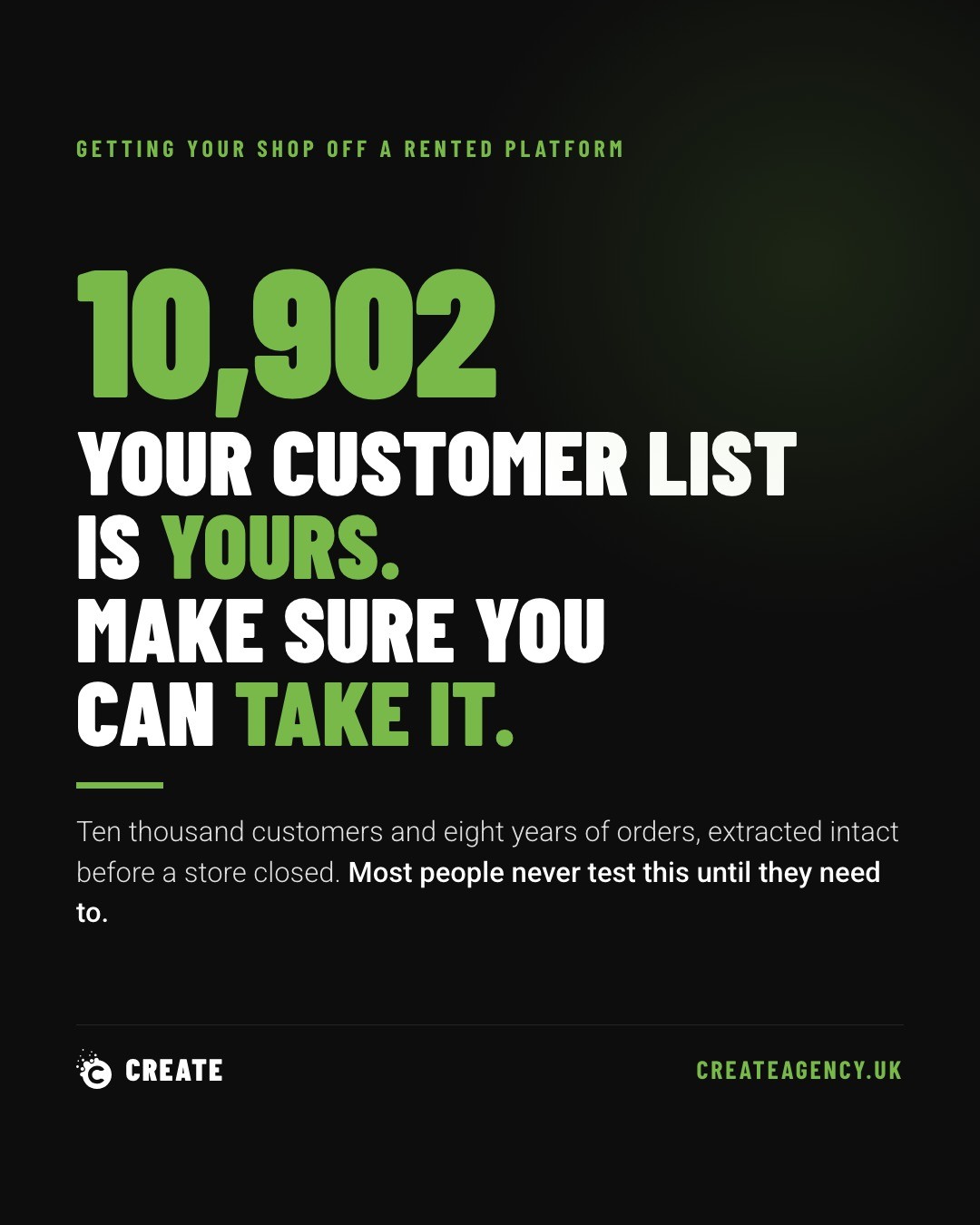
We found out the hard way how rarely the answer is yes. We recently spent part of a month extracting a client's shop from a rented e-commerce platform before their subscription lapsed. The numbers were not small: 10,902 customers, just over 8,000 orders dating back to 2022, every product record, and the full image library. All of it needed to come out complete, not as a partial export with gaps the client would only discover months later.
Renting a platform means renting your own data
Subscription e-commerce platforms are built to make joining easy and leaving hard. That is not an accident; it is the business model. The longer a merchant's order history, customer records and product catalogue live inside one system, the more painful migration becomes, and the more likely that merchant is to renew rather than fight the export tools.
The trouble is that most businesses do not discover this until the day it matters: a price rise, a feature removed, a platform acquired and quietly wound down. By then there is no time to test anything properly. Whatever the export delivers is what the business gets.
What a real export actually needs to contain
A product feed with titles and prices is not a migration. A genuine export needs order history going back as far as the business has traded, full customer records including consent data for marketing compliance, and product photography at the resolution it was originally uploaded, not a compressed thumbnail version that looks fine in a list view and terrible on a product page.
On this project, those were exactly the gaps that mattered. Order history going back to 2022 had to reconcile against existing customer accounts. Image libraries had to come across at full resolution so the new site did not look like a downgrade. None of this is exotic. It is simply the stuff that platforms do not prioritise when they design their export tools, because export tools exist to satisfy a checkbox, not to serve the merchant who is leaving.
The test every online seller should run this week
There is a simple way to find out whether a business is actually in control of its own data: export everything, right now, with no deadline pressure and no subscription about to expire. Open the file. Check that customer records are complete. Check that order history goes back as far as expected. Check that images are full size, not thumbnails.
Most businesses who do this for the first time find something missing. Better to find it on a quiet Tuesday than on the last day of a cancelled subscription, when there is no leverage left to ask the platform for help.
Why this matters more as platforms consolidate
E-commerce platforms get bought, merged and deprecated more often than merchants expect. A platform that feels stable today can be absorbed into a larger company within a couple of years, with pricing and feature changes that follow soon after. Businesses that have never tested their own exit are the ones who end up negotiating from a position of zero leverage, because the alternative to accepting a price rise is potentially losing years of customer and order data.
This is not an argument against any particular platform. It is an argument for treating data portability as a basic piece of commercial hygiene, in the same category as backing up a website or renewing a domain before it lapses. Twenty-five years in digital work has taught us that the businesses who survive platform changes unscathed are almost always the ones who checked their exports before they needed to, not after.
If a shop's platform costs have crept up, or there is simply a nagging doubt about what would happen if the subscription ended tomorrow, it is worth having someone look at the actual data rather than the marketing promises. We handle migrations like this as part of our wider e-commerce and web development work, and we are always happy to talk through what a clean export should look like before there is any pressure to move. If that conversation would help, book a call.