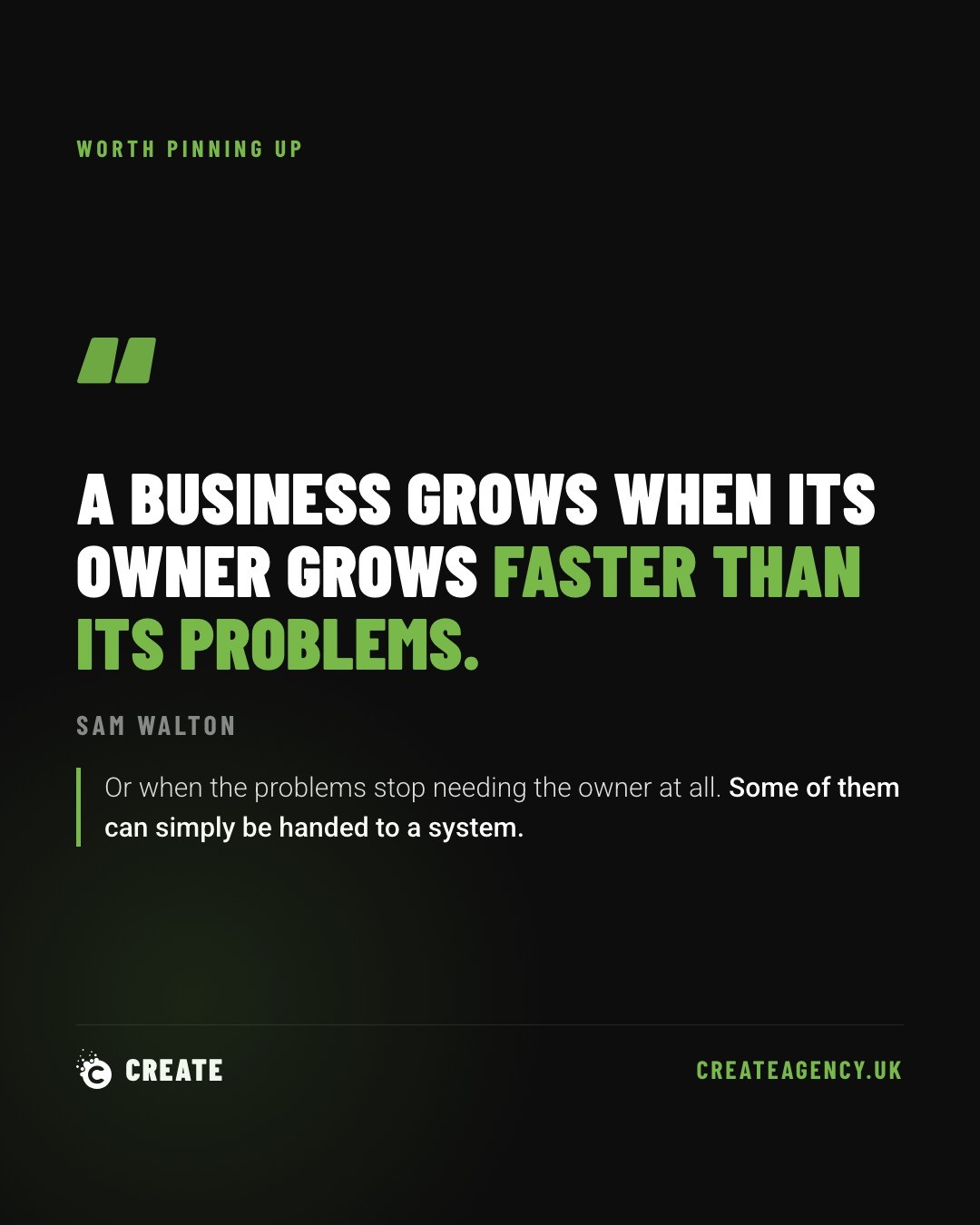
Sam Walton once said a business grows when its owner grows faster than its problems. It's a good line, and mostly true. But it misses a second route entirely, one we see small business owners miss constantly: some problems don't need you to get better at handling them. They need to stop being your problem in the first place.
Every small business carries a list of jobs that only happen because somebody remembers to do them. Sending the quote before the customer loses interest. Chasing the deposit. Asking for the review while the job is still fresh in the client's mind. Routing the enquiry to the right person instead of letting it sit in a shared inbox for three days. Updating the opening hours before a bank holiday so nobody turns up to a locked door.
None of these tasks make anyone better at running a business. They're not strategy. They're not growth. They're maintenance, and they fall apart the moment the person who usually remembers them is ill, on holiday, or simply busy with something else.
The Wrong Question Owners Ask
When a task like this starts causing problems, the instinct is to ask how to get faster at it. Tighter processes, a better checklist, a reminder app. That's fixing the symptom.
The better question is whether the task needs a person at all. A huge number of these jobs are pattern-based: if this happens, do that. A new enquiry comes in, it goes to the right inbox. A deposit is overdue, a chase email goes out. A job finishes, a review request follows automatically three days later. None of that requires judgement. It requires consistency, which is precisely what software is better at than people.
We've built this logic into client websites for years without necessarily calling it automation. A contact form that routes by service type. A booking system that blocks out bank holidays automatically. An e-commerce store that chases abandoned baskets without anyone lifting a finger. These aren't exotic additions. They're basic plumbing that most small business websites still lack.
Where Growth Actually Belongs
The Walton principle still holds for the things that genuinely need a human getting better: sales conversations, pricing decisions, hiring, the relationships that keep clients coming back. Nobody should be trying to automate their way out of judgement calls. That's where an owner's time and energy belong.
The mistake is treating every task on the to-do list as if it deserves that same investment of personal growth. Chasing a deposit is not a leadership skill. It's an admin task wearing a disguise. Confusing the two is how owners end up exhausted by work that was never worth their attention in the first place.
Auditing the Admin Pile
A useful exercise, and one we run with clients fairly often, is to list every recurring task that currently depends on a person remembering it. Not the big strategic stuff, the small repetitive stuff. Then ask of each one: does this require a decision, or does it require consistency?
Tasks requiring consistency are candidates for automation, whether that's a website workflow, an email trigger, a CRM rule, or in some cases a lightweight AI tool handling first-line enquiries. Tasks requiring a genuine decision stay with a person. Most small businesses find the list splits roughly in favour of automation once they're honest about it.
This is also where a lot of websites quietly cost businesses money. A site that just displays opening hours and a phone number is leaving every one of these jobs to a human. A site built with the right logic underneath removes a dozen small failure points without anyone having to think about it again.
Building Systems That Do Not Forget
The appeal of fixing this properly, rather than patching it with reminders and good intentions, is that it never has an off day. It doesn't forget the bank holiday hours. It doesn't skip the review request because the week got busy. It just runs.
That's the second route Walton didn't mention. Growing faster than your problems works for the problems worth growing into. For the rest, the better move is building something that stops the problem landing on a person at all.
If part of the admin pile in your business sounds exactly like this, it's worth a conversation about which bits of your website or workflow could be doing more of that work for you. We've helped plenty of small businesses work through exactly this list, and you can book a call to talk through yours.