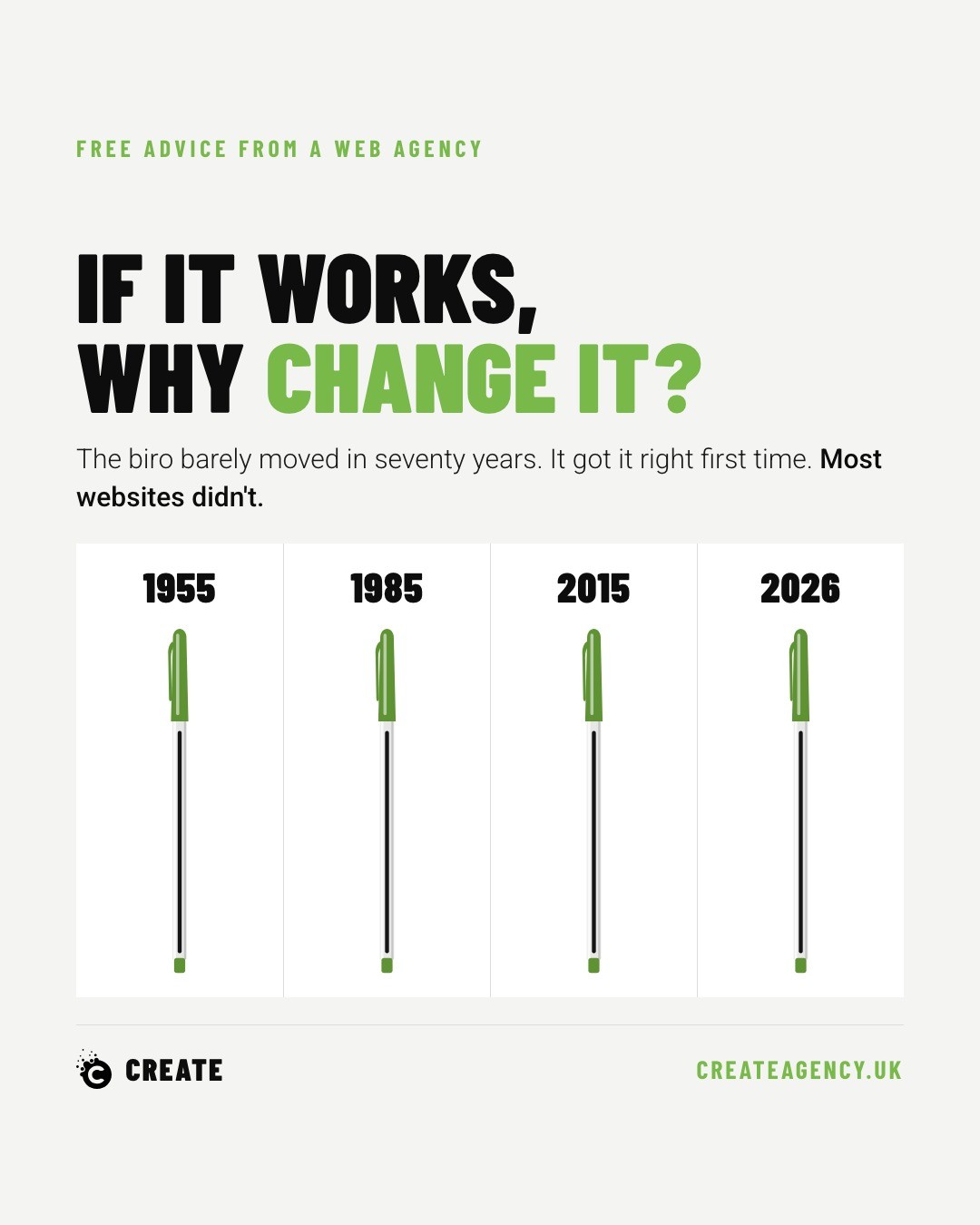
The biro has barely changed since 1955. Same barrel, same cap, same six-sided grip. Seventy years of design progress and the pen on your desk is near enough identical to the one your grandad carried around.
Nobody redesigned it, because it worked. That principle applies to a lot more than stationery, and we think about it constantly, because we build websites for a living. The honest answer to "should we redesign our site" is often no. If it loads quickly, says the right thing, and the phone rings, spend the budget on stock or staff instead.
But most of the websites we get asked to look at are not fine, and the owner usually already knows it. They just cannot always point at why. That's the gap we want to close here.
The Five Signs a Site Needs Fixing, Not Rebuilding
After three decades of doing this, the same handful of problems turn up again and again. None of them require starting from scratch.
It takes too long to load on a phone. Four seconds is the point where most visitors give up and go back to Google. If a site is built on old, bloated code or hasn't had its images optimised in years, that delay is almost always fixable without touching the design.
The enquiry form goes nowhere useful. We've lost count of the sites where the contact form quietly points at an inbox nobody has checked since 2023, or a staff member who left the business two years ago. Nobody notices until someone asks why enquiries have dried up.
The content describes a business that no longer exists. Services change, pricing changes, teams change. A site that still talks about what the business did five years ago is actively working against the business it is today.
It behaves on desktop and falls apart on mobile. Most traffic now arrives on a phone. If the layout was designed and tested on a laptop and never properly checked on a handset, that's not a small cosmetic issue, it's the majority of visitors getting a broken experience.
Google has quietly stopped bothering with it. Search engines reward sites that show signs of life: fresh content, technical health, activity. A site left untouched for years tends to slide down the rankings slowly enough that nobody notices until traffic has genuinely dried up.
Why This Matters More Than It Looks Like It Does
Each of those problems sounds minor on its own. Together, they add up to a website that is quietly costing a business enquiries every week, without anyone being able to say exactly why.
The temptation, once a business owner notices the site feels tired, is to assume the whole thing needs replacing. That's rarely true, and it's rarely the cheapest or fastest fix. A full redesign is a big commitment of budget and time. A repair job, aimed at the actual problem, usually isn't.
Diagnosis Before Treatment
The skill here isn't building websites, it's diagnosing what's actually wrong with one. A slow load time and a form pointing at a dead inbox look identical from the front end: fewer enquiries, no obvious cause. But the fix for one is a few hours of technical work, and the fix for the other is one line of code and a working email address.
That's the approach we take with every site audit: work out what's actually broken before recommending what to do about it. Sometimes that means a redesign is genuinely the right call, particularly if the business itself has changed shape entirely. More often, it means a targeted repair that gets the site performing again without the cost or disruption of rebuilding it from the ground up.
The Real Question to Ask First
Before spending money on a new site, it's worth asking a simpler question: does this one actually work? Does it load fast, say the right thing, and generate enquiries that go somewhere real?
If the answer is yes, the biro rule applies. Leave it alone and spend the money elsewhere.
If the answer is no, or if it's a shrug, that's usually a smaller job than people expect. If any of those five problems sound familiar, it's worth booking a call to talk through what's actually going wrong before deciding what to do about it.